Power Transformer Manufacturing Business
QUICK FACTS FOR INVESTORS & MSME PROMOTERS
- India’s power & distribution transformer market is expected to reach USD 8.41 billion by 2030, expanding at a rate of ~10.84% CAGR.
- Recent reports indicated that only 0.44 million of 5 million sanctioned smart transformers had been installed, with the rest in the backlog to be sold to the business.
- The biggest constraint and the biggest opportunity for the steel industry is its gap, which is 30.6% in India with the production of just 50,000 tonnes against the demand of 4,00,000 tonnes of CRGO steel.
- Solar IDT market is expanding in the fastest rate (11.1% CAGR) in India’s electrical equipment market.
- The global transformer supply chain is overstretched: The lead time for large power units is over 24-48 months, and the manufacturing of transformers in India is an export opportunity of historic size.
Reading the Room: Why This Sector Demands Attention Right Now
Most of the manufacturing opportunities lie right under our noses, in trade data, in consumption patterns, and in unique industry reports. The situation is just the opposite for the power transformer market in India. It is audible, recorded and substantiated by several lakh crore rupees of government investment. The lack of evidence is not the reason entrepreneurs hesitate; it is the technical reputation of the sector. Transformers are not consumer product. However, that sense of complexity is exactly what helps keep competition to a minimum that demand warrants, and it’s exactly why it’s a good time for well-prepared competitors.
India’s total installed renewable energy power reached 226 GW. India installed more than 52,000 MW of new electricity generation capacity in one year recently, setting a country record, according to the Central Electricity Authority (CEA). By the end of this decade, it is expected that electricity demand will reach more than 400 GW. According to the National Electricity Plan, the demand for new transmission lines is more than 1,23,577 circuit kilometres and the demand for substation capacity is more than 8,27,600 MVA. They are needed at each substation of that plan, for a solar park, wind farm, metro rail feeder, or DISCOM upgrade. Instead of one or two, whole procurement lots.
At the same time, there is a significant stress on the global transformer supply chain. The lead time for large power transformers has grown to more than 24 months throughout the world and up to 48 months for special units. In a recent period, industry analysts estimated that the U.S. was in for a 30% shortfall in the production of large power transformers. Indian transformer manufacturing has evolved from a local business into an international demand source, due to this global tightness, which was virtually absent five years ago.
Get Detailed Project Report (DPR): Complete Guide to Transformer & Power Equipment Manufacturing
The power transformer sector, with a particular focus on oil-filled distribution transformers, solar Inverter Duty Transformers, and wind energy transformers, presents a unique blend of favorable conditions for MSME promoters considering a new manufacturing opportunity, investors seeking investment options beyond real estate and trading, and bold first-generation entrepreneurs aiming to master a technically complex industry that is increasingly becoming important for export.
Segment 1 — Oil-Filled Distribution Transformers (Up to 2.5 MVA, 36 kV Class)
The Backlog That Becomes a Business Case
Of 5 million transformers approved across a number of national electrification and distribution modernization projects, only 0.44 million have been erected, leaving most industry analysts stumped on that figure. That’s a backlog of more than 4.5 million units scheduled to be installed, which will continue to support orders at least through 2027 without any new sanction that would be added today. Of course, new sanctions are being added on a regular basis in the Revamped Distribution Sector Scheme (RDSS) with an outlay of Rs 3,03,758 crore, and Central Government budgetary support of Rs 97,631 crore – the biggest single distribution infrastructure programme in India’s history.
For transformer manufacturers, there are two dimensions that are important for the RDSS. First, it calls for DISCOMs to go below their current national average of about 16% AT&C to the 12-15% range, by replacing existing physical transformers and installing new substations in high loss circuits. Second, it is a reforms-based programme: DISCOMs not meeting the performance milestones will lose access to Central grants, thus driving a sense of urgency in procurement for DISCOMs as opposed to purely discretionary programmes. Even in states where budgets have been tight, procurement budgets are being made available because state utilities can’t afford to fall short of RDSS performance benchmarks.(Power Transformer Manufacturing Business)
The BEE Mandate: A Hidden Replacement Wave
In addition to the expansion procurement due to the RDSS, there is an efficiency-compliance replacement wave that has been set in motion by the star-label upgrade mandate for distribution transformers by the Bureau of Energy Efficiency (BEE). The mandate is for distribution transformers to be more efficient — which is forcing utilities to phase out older transformers that don’t meet the new minimum efficiency requirements. This regulation is a commercial gift for manufacturers that have invested in higher grade CRGO cores and precision winding equipment that can produce 4-star and 5-star rated coils. This regulation is a commercial gift to the manufacturers which have invested in higher grade CRGO cores and precision winding which can produce 4-star and 5-star rated coils as they shift a working asset into a liability creating replacement orders which are not related to load growth.
The distribution transformer market has been undergoing 3 simultaneous procurement triggers: RDSS new installations, BEE replacement cycle, and rural electrification additions under PM-Saubhagya, which are creating a ‘seller’s market’ according to industry analysts at major research firms, with an order book of 12–18 months at established manufacturers.
Geography of Demand
Western India is the largest market for transformers with Maharashtra and Gujarat contributing around 29-33% of the country’s demand. The solar parks in Kutch, wind farms across Saurashtra and hybrid projects across the zones of Rajasthan-Gujarat demand a large number of distribution and step-up transformers. The other major procurement geographies are Tamil Nadu, Rajasthan, Uttar Pradesh, Madhya Pradesh and Andhra Pradesh. This is where India’s largest solar installations of more than 18 GW exist and Rajasthan is one of the most active single state markets for distribution transformers and solar specific transformers.
The CRGO Constraint: Structural Risk and Hidden Opportunity
The material used as the core of a transformer that affects metal loss and efficiency is called cold rolled grain oriented (CRGO) electrical steel. The available domestic CRGO production of about 50,000 tonnes per year is limited to a single facility and only satisfies 10 – 12% of the country’s requirement of about 4,00,000 tonnes per year. However, the structural deficit is more than 122,000 tonnes, or 30.6% of the requirement, as revealed by the Global Trade Research Initiative (GTRI) and reported by Business Standard, despite the fact that the gap is being filled by imports from China, Japan, Russia and South Korea to the maximum extent.(Power Transformer Manufacturing Business)
The Quality Control Order also imposes additional restrictions on the types and grades of foreign CRGO that are allowed to be used, and license renewals have led to periodic supply disruptions, particularly affecting MSME manufacturers. Due to the BEE efficiency mandate’s transition to higher-grade core materials, the demand for CRGO is expected to rise by 10-12% annually through 2030, with the rise in transformer demand also contributing. The single development that has taken a step forward on the upstream side is the plan that the JSW JFE Electrical Steel (JSW JFE) has taken the board’s approval for its expansion of the Nashik plant from 50,000 TPA to 2,50,000 TPA with a capital outlay of Rs 200 crore.
Segment 2 — Solar Inverter Duty Transformers (Up to 20,000 kVA, 36 kV Class)
Why Solar Parks Cannot Use Standard Transformers
The worst thing a solar project developer can do is thinking that a distribution transformer and a duty transformer (IDT) for a solar inverter can be substituted. They are not. Harmonic distortion – non-sinusoidal waveforms that are not designed to be carried by standard transformers – is present in the output current from solar inverters. The harmonic currents produce extra eddy current losses in the transformer core and windings resulting in increased heat generation, which leads up to a degradation rate that is several times higher than the rated design life for a standard distribution transformer. The substitution by project developers to reduce the initial cost will usually result in replacement of the transformer within 3-7 years of projects being designed to last 25 years — a lifecycle cost disaster.
IDTs address this issue using k-factor rated designs: Uprated neutral conductors designed to carry triple harmonic currents, lower core flux density to prevent eddy current losses under the harmonic loading condition, and higher thermal class insulation (F or H class insulation instead of standard A or E class insulation), and reinforced winding bracing to maintain the geometry through the daily thermal cycling occurring during solar operation. All these make the number of qualified domestic suppliers limited and those who invest in the process to qualify the certifications (IEC 61378 for converter transformers) limited.(Power Transformer Manufacturing Business)
Get Detailed Insights from This Book: Solar PV Power and Solar Products Handbook
Market Scale and Why the Supply Side Is Thin
The Indian IDT market is expected to expand at a CAGR of 11.1% during the forecast period. It will be the fastest-growing sub-segment of the Indian electrical equipment market.
The fleet is outstanding in terms of diversity. It includes utility-scale solar projects under the National Solar Mission and SECI. It also includes solar pumps across millions of farm connections. Commercial and industrial rooftop solar projects operate under the PM-Surya Ghar Muft Bijli Yojana (Rs 75,000 crore). In addition, manufacturing facilities and data centres use captive solar to reduce their dependence on the grid.
The nodal organisation for tendering large solar projects, Solar Energy Corporation of India (SECI), has released the Letters of Award (LoA) for around 39,600 MW of solar manufacturing capacity under the PLI Tranche II. IDT equipment is necessary to connect the output of the inverter to the grid for every MW of solar power deployed. In comparison, the supply side on the MSME is still underdeveloped – limited number of manufacturers in India are having IEC 61378 compliant IDT design, full type test certification and engineering capability to produce units in 5,000-20,000 kVA. This leaves a disconnect between solar developers’ requirements and what the domestic supply side can consistently provide, especially in the mid-to-large size range where developers regularly have to import from Europe or China and wait for long delivery lead times.
Application Segmentation: Where Revenue Concentrates
Three-phase IDTs dominate the revenue market, and are the most widely used inverter topology for large scale solar parks procurement. The power band 5.1-10 MVA is the most profitable with the rapid growth of mid-sized commercial solar farms and industrial captive installations. The 10,000-20,000 kVA segment is the biggest import substitution area with premium solar developers, including IPPs operating large solar parks in Rajasthan and Gujarat are ready to switch to alternative domestic suppliers that can guarantee type-test compliance and delivery reliability.(Power Transformer Manufacturing Business)
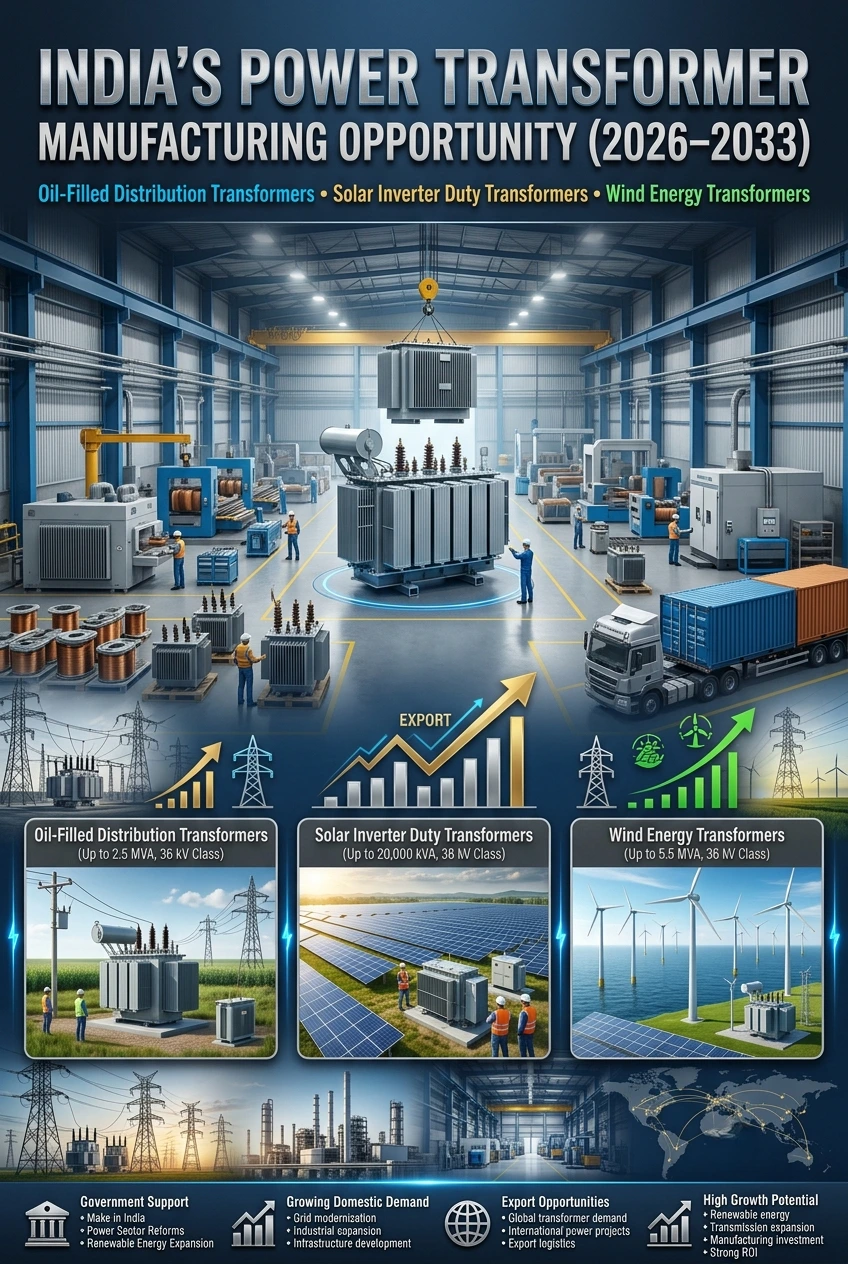
Segment 3 — Wind Energy Transformers (Up to 5.5 MVA, 36 kV Class)
The specification of wind turbine transformers is one of the most challenging in the electrical equipment industry. The rotating machinery above the nacelle-mounted transformer continuously generates mechanical vibrations. Site elevation and seasonal changes also cause temperatures to fluctuate between -10°C and +50°C. In addition, changing wind speeds create daily power ramp cycles that affect the transformer. This class of 5.5 MVA, 36 kV covers the requirement of the existing generation of onshore wind turbines in India ranging between 2MW to 5MW+ GW capability.
The wind energy development pipeline in India, run by the Ministry of New and Renewable Energy (MNRE), consists of onshore projects in Rajasthan, Gujarat, Tamil Nadu, Maharashtra and Andhra Pradesh, as well as an emerging offshore wind programme with up to 30 GW of projects planned for the next 10 years. A Wind Turbine Generator (WTG) directly connects to a step-up transformer in the 33 kV collection system. Therefore, the number of new wind turbines commissioned directly influences wind transformer procurement.
Leading Indian wind turbine manufacturers — including Suzlon Energy, Inox Wind, and Envision India — are migrating toward 3 MW, 4 MW, and 5 MW+ turbine platforms to improve capacity utilisation on existing wind resource sites where smaller turbines have already been installed. This migration shifts the wind transformer demand profile toward the upper end of the 5.5 MVA range and makes it a more specialised, lower-competition segment for manufacturers willing to invest in WTG OEM type-testing and approved vendor qualification processes. The time investment is 18–24 months from application to first supply. The reward is stable, repeat-order relationships with wind project developers who procure transformers as a standard BOM item for each turbine commissioned.(Power Transformer Manufacturing Business)
SWOT Analysis: Power Transformer Manufacturing in India
| STRENGTHS | WEAKNESSES |
| • 500+ manufacturers across all voltage classes • Deep engineering talent — IITs, NITs, CPRI testing labs • 25–40% cost advantage vs. European/Japanese OEMs • Mature BIS/IS 1180 and IS 2026 certification ecosystem • Strong domestic copper and insulation material supply base • Large, experienced MSME cluster in distribution transformer segment | • ~90% CRGO import dependency — only 10–12% domestic production • BIS license renewal delays cause recurring raw material disruptions • Very few IEC 61378-certified IDT manufacturers at mid-large capacity • Limited nacelle-rated wind transformer specialists • DISCOM payment delays create working capital pressure • Quality inconsistency at lower-tier MSME level affects sector credibility |
| OPPORTUNITIES | THREATS |
| • 4.5 million+ transformer installation backlogs under RDSS • 500 GW RE target = sustained IDT and wind transformer demand • Global supply tightness (24–48-month lead times) creating export window • PM-Surya Ghar Rs 75,000 crore rooftop solar programme • EV charging infrastructure requiring distribution transformers • JSW JFE CRGO expansion to 2,50,000 TPA easing core material supply • India as ‘China+1’ sourcing destination for global transformer buyers | • Chinese OEMs (TBEA and others) competing aggressively in Indian utility tenders • Copper and CRGO price volatility compressing fixed-price contract margins • Anti-dumping investigation on CRGO creating pricing uncertainty • DISCOM financial stress causing tender delays and payment deferrals • Long WTG OEM approval cycles for new wind transformer entrants • Global copper market tightness pushing input costs higher |
Demand–Supply Gap: Three Gaps, Three Different Entry Strategies
The demand-supply gap in the transformer segment is far from being uniform. It has its own qualities for each of the three segments, and knowing these differences will guide the type of entry strategy that will fit a specific investor profile, amount of money invested, and level of technical expertise.
The Volume Gap: Distribution Transformers
The volume gap in the distribution segment is simple. Manufacturers have expanded capacity more slowly than sanctioned installations, especially in the 100 kVA to 1,000 kVA range, which accounts for most DISCOM procurement. Standard delivery time for books from established manufacturers is 12-18 months. States such as Rajasthan, Uttar Pradesh, Madhya Pradesh and Bihar have actively implemented RDSS and are issuing the largest volumes of tenders. These states are also demanding higher quantities than regional manufacturers can produce in a short time. This is the easiest entry point: A facility that is certified by the BIS that has good process controls and a viable supply chain for the CRGO will have buyers before production starts.
The Specialisation Gap: Solar IDTs
The IDT gap is not a quantitative gap; it’s a capacity gap. There are ample number of transformer manufacturing companies in the country of India. What’s missing is the subset of designs that are IEC 61378 compliant, and have validated harmonic performance data and type test certifications from accredited international labs that solar project developers need. The biggest gap exists in the smaller capacity range of 5,000 to 20,000 kVA. Premium solar park developers must purchase from a limited number of certified local suppliers or wait for their products, often facing long lead times. The engineering design, the IEC testing, the reference supply to an anchor solar customer: A manufacturer who invests is entering a segment that has disproportionately good margins and few direct competitors.
The Approval Gap: Wind Transformers
The gap in the wind transformer is mainly a qualification gap. WTG OEMs have closed approved-vendor lists and without OEM qualification a manufacturer will have no business in supplying to new wind projects whether they have the production capacity or not. Typically, the qualification process of type-testing vibration resistance, thermal cycling and nacelle-environment compliance, followed by pilot supply and OEM evaluation takes 18-24 months. This is a high barrier which excludes majority of MSME manufacturers. However, once the OEM clears the supplier, the supplier secures a stable, long-term contract. The contract guarantees annual volumes based on the wind turbine generator commissioning schedule. The OEM’s procurement team also limits renegotiation because it prefers supplier continuity over frequent changes.(Power Transformer Manufacturing Business)
Identify high-growth industries before others do
| Factor | Oil-Filled DTs (≤2.5 MVA) | Solar IDTs (≤20,000 kVA) | Wind Transformers (≤5.5 MVA) |
| Gap Type | Volume gap — demand exceeds installed production capacity | Specialisation gap — capability shortage, not volume | Approval gap — WTG OEM qualification required |
| Market CAGR | ~10.84% (power + distribution) | ~11.1% (IDT segment) | ~9–11% (wind transformer) |
| Core Raw Material Risk | CRGO: 30.6% structural shortfall; 90% import dependency | Same CRGO dependency; additional IEC-grade insulation systems | CRGO + specialised core lamination grades for vibration resistance |
| Primary Demand Source | RDSS, BEE star-label mandate, rural electrification | 500 GW RE target, PM-KUSUM, PM-Surya Ghar, Solar Park Scheme | National wind capacity addition, WTG fleet scale-up, offshore wind |
| MSME Qualification Timeline | 12–18 months (BIS licence + DISCOM reference supply) | 18–24 months (IEC 61378 type-testing + solar EPC reference) | 18–24 months (WTG OEM approval + pilot supply) |
| Entry Capital Estimate | Rs 5–25 crore depending on capacity and testing setup | Rs 20–60 crore including IEC design and testing investment | Rs 25–65 crore including vibration test capability |
| Margin Profile vs. Standard DTs | Baseline — commodity segment; margin under CRGO price pressure | 30–50% price premium; protected by technical certification barrier | 15–35% premium; stable long-term contracts protect margins |
Government Incentives: The Policy Stack That De-Risks Entry
The most encouraging result of a feasibility study is the strong policy support available for entrepreneurs entering the transformer manufacturing business. Several government schemes offer demand- and supply-side incentives. Together, these schemes have created one of the most supportive industrial policy environments in India’s manufacturing history.(Power Transformer Manufacturing Business)
1. RDSS — Revamped Distribution Sector Scheme
Administered by the Ministry of Power, the scheme is the biggest source of demand for distribution transformer procurement. It has received Rs 97,631 crore in support from the Central Government. Its reforms-based structure relies on the performance of DISCOMs. Therefore, procurement urgency remains high even in states with limited utility budgets. Manufacturers that qualify under the RDSS DPR frameworks can access large tender volumes. These tenders may involve tens of thousands of units each quarter at the state level.
2. PM-KUSUM, Solar Rooftop Phase II, and PM-Surya Ghar Muft Bijli Yojana
collectively add up to tens of thousands of crores committed to the installation of solar energy, and each installation will require IDT equipment. The PM-Surya Ghar scheme is committed to Rs 75,000 crore for rooftop solar for residences. The tender documents for IDT are made public by the SECI.
3. PLI Framework and Make in India
coordinated by DPIIT, has resulted in nearly Rs 1.76 lakh crore of committed investments in manufacturing in 14 sectors. While the transformer industry is not a direct PLI beneficiary, the PLI-induced growth in solar PV manufacturing capacity results in the creation of customer base for IDT manufacturers. Gujarat, Maharashtra and Tamil Nadu include electrical equipment manufacturing under their PLI and capital subsidy schemes. These states provide capital subsidies on fixed assets to eligible MSMEs that meet the required criteria.
4. MSME Credit and Technology Support
Scheme of the Ministry of MSME, which provides micro enterprises access to working capital loans and term loans of up to Rs 5 crore and small enterprises up to Rs 10 crore respectively under the Credit Guarantee Fund Trust (CGTMSE) without requiring any collateral. The Technology Upgradation and Cluster Development Programmes directly cater to electrical equipment MSMEs, offering them subsidized access to testing equipment, product certifications and common facility centers.(Power Transformer Manufacturing Business)
5. BEE Energy Efficiency Mandate
The distribution transformer standards, effective from January 2025, will create replacement demand. They will also help quality-focused manufacturers secure premium prices. Manufacturers producing 5-star-rated equipment need higher-grade CRGO and tighter winding tolerances. Therefore, they can charge higher prices than commodity-level products. This also helps them avoid the most competitive DISCOM bidding rounds.
6. Industry Advocacy and Export Facilitation
Transformer manufacturing is placed under Make in India and CRGO import duty rationalisation, export incentive expansion and reform in BIS certification process are being advocated by the Federation of Indian Chambers of Commerce and Industry (FICCI) from the industry’s perspective. Transformer manufacturers can avail market intelligence, buyer meet facilitation and export documentation support from the Engineering Export Promotion Council (EEPC India) for the markets in Africa, ASEAN & Middle East.(Power Transformer Manufacturing Business
Major Indian Players: Understanding the Competitive Landscape
The Established Heavyweights
BHEL (Bharat Heavy Electricals Limited)
The largest engineering public sector enterprise in India and the benchmark firm in Central Utility Power Transformer procurement in India. BHEL has the capability of producing up to 800KV and has an outstanding track record in the field of manufacturing for POWERGRID, State Transmission Utilities and International grid Projects, and therefore established the quality benchmark for other manufacturers. For instance, a recent BHEL-Hitachi consortium contract to build an INR 1200 crore HVDC converter station shows how big Tier-1 players are.(Power Transformer Manufacturing Business)
CG Power and Industrial Solutions Ltd
The Rs 712 crore greenfield plant investment that involves in-house CRGO slitting and resin casting with a capacity addition of 45,000 MVA/y by FY28 is a testament to how vertical integration is the key to achieving competitive advantage at the mid-to-large transformer size. The presence of CG in more than 100 countries for exports further makes it the most internationally visible Indian industry manufacturer.
Hitachi Energy India Ltd
(Formerly ABB Power Products India) is at the top of the premium quality and technology in the Indian transformer industry. Its HVDC converter transformer function, digital condition monitoring integration and ecofriendly insulation fluid products are defining products for the industry. POWERGRID’s most technically challenging grid projects go to Hitachi Energy.
Transformers & Rectifiers (India) Ltd (TRIL), Voltamp Transformers, Bharat Bijlee Ltd
Voltamp Transformers and Bharat Bijlee Ltd that fixed Rs 235 crore for expansion of its Airoli plant to 35,000 MVA. Voltamp has now got another distribution transformer order worth Rs 41 crore from Adani Power. TRIL secured Rs 362 crore of additional orders for its EHV products, both from POWERGRID and from private developers. The revenue growth of focused specialists like Danish Power Limited is approximately 42% CAGR over the 3 years, which shows the growth rates available in the renewable energy transformer market.
The MSME Tier: 400+ Regional Manufacturers
MSMEs have a major presence in the transformer market in India, making tenders for distribution transformers (less than 2.5MVA) for state DISCOMs, agricultural pump connections and small industrial units. They enjoy competitive benefits such as closeness to utility procurement offices, being able to produce small batches, and low overheads. They are most susceptible to CRGO price and availability risk, and to the rising quality expectations due to BEE efficiency mandates and utility procurement scorecards.(Power Transformer Manufacturing Business)
Startup Opportunity Insight: Making the Case for New Entrants
Why Now Is Different from Five Years Ago
The case for investing in transformer manufacturing was similar five years ago. Electricity demand was increasing, government initiatives were expanding, and MSME-friendly investment norms were available. Today, however, the demand pipeline is larger and more visible. Global supply chain constraints have also made Indian manufacturing a strong export opportunity. In addition, renewable energy has created new demand segments. IDTs and wind transformers were virtually non-existent five years ago.
A new entrant in the distribution transformer market comes into the market today with RDSS procurement intelligence, capex based on a published DISCOM plan in states with a multi-year procurement plan, and a BEE efficiency mandate to propel it. The risk which generally deters manufacturing investment — “will there be buyers??” is quite low in this sector compared to virtually all other manufacturing categories at this size.
The IDT Entry Thesis
For a promoter prepared to invest in additional engineering capability, designing and certifying products to comply with IEC 61378 offers a much stronger business case than manufacturing commodity distribution transformers. Solar project developers – who are handling projects ranging Rs 500 crore to Rs 5,000 crore – are not as price sensitive as state DISCOM project procurement officers. They assess transformer suppliers regarding compliance to type tests, delivery reliability, and technical support capability. A manufacturer who passes those tests can charge a 30–50% mark-up over commodity distribution transformers for every unit he sells.
The export aspect adds to the IDT thesis. India is emerging as a ‘China+1’ source for the global customer of transformers. European companies typically over-design their products for the high temperatures and uneven climatic conditions of the Middle East and Sub-Saharan Africa. Meanwhile, purchasers in these regions increasingly reject Chinese products, which keeps Indian manufacturers with IEC-compliant IDT designs in a strong position in these markets.(Power Transformer Manufacturing Business)
How to Think About the Capital Requirement
The project cost for starting a BIS certified oil-filled distribution transformer manufacturing unit of 25-KVA to 2,500-KVA capacity varies from Rs. 5-25 cr. depending upon the installed capacity and depth of testing infrastructure. This can be achieved through MSME credit schemes, term lending by SIDBI and state capital subsidy schemes. The cost of the IDT focused unit for 1000-10000 kVA is Rs 20 to 60 crore with the premium being the investment in the IEC design and quality systems and the price of IDT units is less competitive, but with a margin of differential it becomes a cost worthy of entry. For promoters lacking expertise in the electrical industry, a techno-economic feasibility study (DPR) prepared by a seasoned industrial consultant is not an optional but an important document that outlines project cost, product mix, machinery specification, working capital requirement and financial projections necessary for bank financing.
NPCS: Feasibility Intelligence for Transformer Manufacturing Ventures
Niir Project Consultancy Services (NPCS) — www.niir.org — prepares Market Survey cum Detailed Techno-Economic Feasibility Reports (DPRs) for entrepreneurs and investors evaluating transformer manufacturing projects across all three sub-segments: oil-filled distribution transformers, solar Inverter Duty Transformers, and wind energy transformers.
The analytical framework to support promoters in making confident investment decisions is provided by a DPR from NPCS, which is a transformer manufacturing company. The manufacturing process description fulfils several requirements. It provides sufficient technical detail to help promoters assess machinery needs, labour qualifications, and floor space requirements before committing capital.
Market research and demand analysis sections are based on utility procurement data, RDSS DPR disclosures, SECI tender histories, CEA capacity addition projections and MNRE renewable energy targets to build a demand case grounded on the promoter’s planned capacity and product mix. Import Export Dependency Analysis is especially useful for IDT and Wind Turbine projects, and provides as much accuracy as investor presentations and bank appraisal teams need to map the global competitive landscape and domestic substitution opportunity.
Related Article: How to Start a Power Transformer Manufacturing Business: Profitable Business Ideas in Oil-Filled, Solar, and Wind Transformers
The project details the machinery and equipment specifications for core slitting lines, CNC winding machines, vacuum oil impregnation plants, HV testing sets, and core annealing furnaces. Domestic and imported sourcing options are also included, along with indicative price ranges.
Raw material specifications cover CRGO laminations, electrolytic copper conductors, mineral transformer oil, and insulating materials. The report also provides sourcing channels and current market benchmarks.
Project financial models include project cost, means of finance, and revenue projections at different capacity utilisation levels. They also cover break-even, IRR, NPV, and payback periods. These models use conservative, base, and optimistic scenarios. This approach gives promoters a realistic range instead of a single-point projection.(Power Transformer Manufacturing Business)
NPCS core objective is to ensure that first-generation entrepreneurs and expanding MSMEs approach investment decisions with the same quality of industrial analysis that large corporates apply — reducing the information asymmetry that too often results in project cost overruns, wrong product mix choices, or market entry timing mistakes. Visit www.niir.org for available report titles and consulting services across transformer manufacturing and adjacent electrical equipment segments.
Frequently Asked Questions
Q1. How does a new transformer manufacturer get onto a state DISCOM’s approved vendor list?
State DISCOM vendor registration typically requires: (a) a valid BIS licence under IS 1180 for oil-cooled distribution transformers, obtained after successful type-testing at a NABL-accredited or BIS-recognised lab such as CPRI or ERDA; (b) factory inspection approval from BIS or the DISCOM’s own technical team; (c) a technical compliance declaration against the DISCOM’s detailed specification (which varies by state); and (d) evidence of prior supply to at least one utility, cooperative, or industrial buyer. New manufacturers typically spend 12–18 months building this documentation package — starting with commercial and cooperative sector sales to generate reference supply records before applying for DISCOM empanelment.
Q2. What is the revenue and profitability profile for a small distribution transformer unit?
A small unit can produce 100–500 BIS-certified oil-filled distribution transformers per month. These transformers can have ratings from 100 kVA to 1,000 kVA. Their average price may range from ₹1.5 lakh to ₹6 lakh per unit, depending on the kVA rating and specifications. Under moderate utilization, the unit can achieve annual revenues of ₹10–20 crore.
For MSMEs with moderate capacities of 100–500 units per month, net margins can range from 8% to 15%. Production costs include CRGO, copper, labor, overheads, and depreciation. CRGO and copper together account for about 55–65% of the total production cost. Strong CRGO sourcing and efficient working capital management can help maintain healthy margins.
DT manufacturers serving the solar segment typically achieve net margins of 18–28% on equivalent-capacity units. These higher margins reflect the price premium and the stricter raw material quality standards in the solar sector.
Q3. What are the export markets for Indian transformer manufacturers, and how does one access them?
The major easily accessible export markets arewithin Sub-Sahran Africa, ASEAN (Bangladesh, Myanmar, Sri Lanka, Vietnam), the Middle East (UAE, Saudi Arabia, Oman) and South America (Brazil, Colombia). Indian manufacturers in most of these markets have cost, climate-spec and logistics advantages. The Engineering Export Promotion Council (EEPC India) organizes buyer-seller meets and trade delegations. It also helps electrical equipment exporters access credit support. Transformer manufacturers can benefit from these initiatives and invest in obtaining IEC standards from professional certification providers in India or abroad. Connecting with global solar EPC firms — who source IDTs for their international project portfolios — is a particularly efficient route to export customers for IDT manufacturers.
Q4. What are the key differences between IS 1180 and IEC 61378 certification, and why does it matter for IDT manufacturers?
IS 1180 is the Indian Standard for oil-immersed power transformers and distribution transformers — it governs the standard distribution transformer that DISCOMs procure. IEC 61378 is the international standard for converter transformers, including those used in solar and wind energy applications. IS 1180 type-testing certifying that a transformer meets standard efficiency, temperature rise, and voltage withstand requirements under sinusoidal 50 Hz operating conditions. IEC 61378 compliance additionally validates performance under harmonic-rich inverter output conditions — the specific stresses that solar IDTs face. Solar project developers with IFC, ADB, or Western institutional financing in their project structure typically require IEC 61378 compliance as a procurement condition. Without it, a manufacturer cannot access institutional-funded solar project procurement regardless of IS 1180 certification status.
Q5. How significant is the global transformer supply shortage for Indian export prospects?
The global transformer supply crunch is creating an unprecedented export opportunity for Indian manufacturers. Lead times for large power transformers have extended to 24–48 months in the U.S. and Europe. As a result, global EPC contractors and utility developers are actively seeking qualified Indian suppliers. They cannot source transformers domestically within the required project timelines.
India offers strong price competitiveness. Indian transformers are 25–40% cheaper than those manufactured in Europe. Major manufacturers have adopted ISO certification, while product quality continues to improve. These factors make India an ideal “China+1” sourcing option. This is especially relevant when procurement diversification is a priority.
The global power transformer market is estimated to reach USD 96.8 billion by 2033. India’s increasing market share could create significant long-term export opportunities.
Q6. Which state offers the best location for a new transformer manufacturing unit?
Gujarat has consistently been the most attractive state for transformer manufacturing investments, given its close proximity to India’s largest renewable energy development zones (Kutch solar/wind and projects along the Rajasthan-Gujarat border), the established industrial ecosystem comprising copper, insulation material and precision engineering supplier clusters, its attractive state capital subsidy programs for electrical equipment MSMEs, and having the largest cluster of transformer manufacturer clients (Solar EPCs, wind developers, industrial customers) within a single state boundary. Among others, the other preferred states are Maharashtra (Pune-Nashik belt), Tamil Nadu (Chennai-Coimbatore belt) and Rajasthan (Jodhpur, Jaipur industrial corridors). For manufacturers supplying distribution transformers to DISCOMs, location is an important factor. Proximity to the state utility’s main procurement office and regional testing laboratory can also influence site selection.