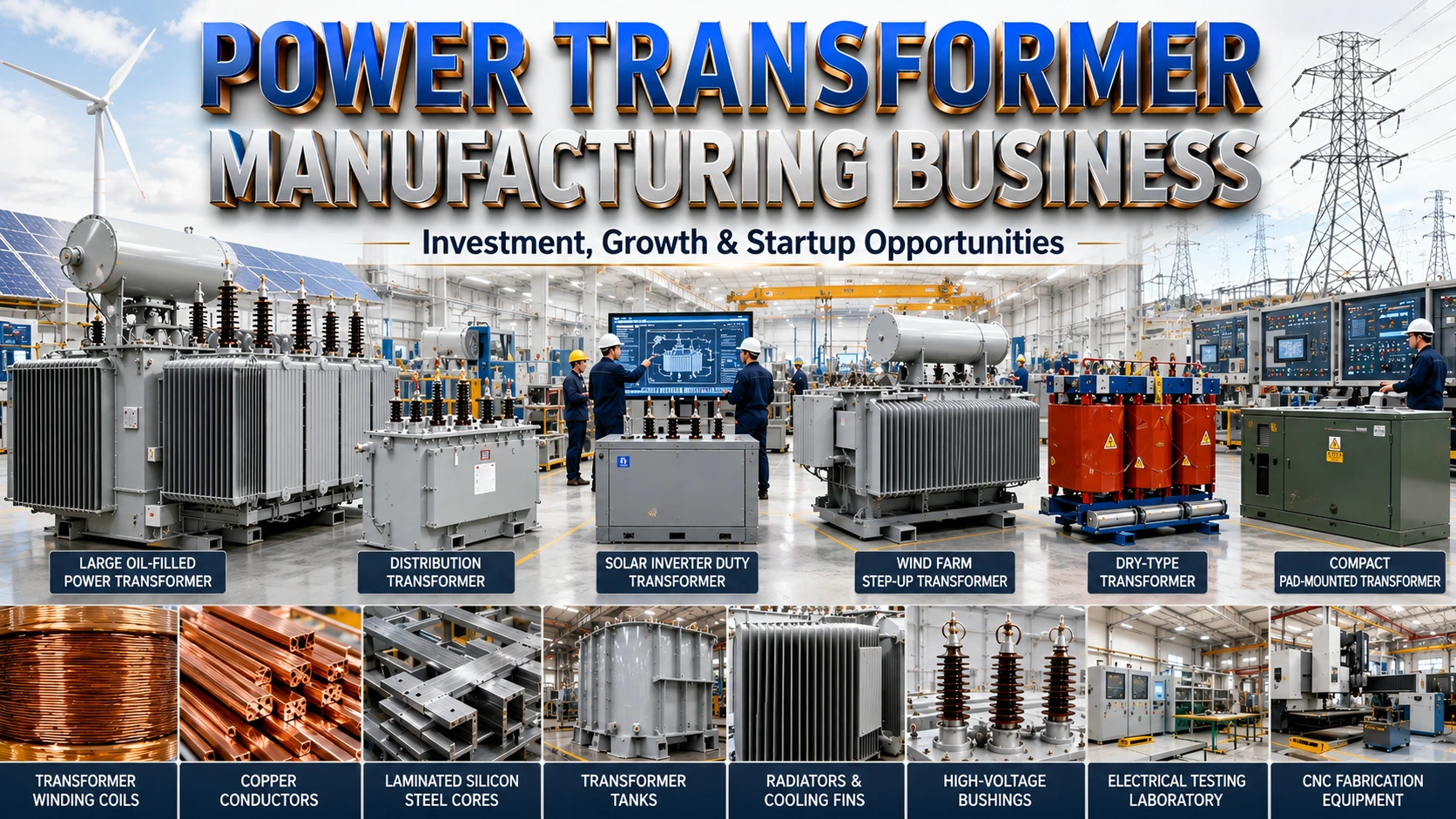

Power Transformer Manufacturing Business
The Opportunity No One Is Talking About
There are certain manufacturing business ideas which can be seasonal. Some are cyclical. Then there are companies that are based on infrastructure, which are stable, government-backed and are growing at a faster rate than that of most other sectors in India. One of the most intriguing business ideas that serious industrial entrepreneurs can pursue these days is in the manufacture of power transformers. From oil-filled distribution transformers for the power grid, solar inverter duty transformers for utility scale renewable power generation, to purpose-built wind transformers for wind turbine installations, all three product lines are seeing record growth.
The addition of capacity is at an unprecedented rate in India. Power companies are investing in outdated power grid infrastructure. Gigawatt scale projects are underway by renewable energy developers. The two trends come together at one key element: the power transformer! However, the capacity of manufacturing, especially MSMEs, has not grown accordingly. That’s a business opportunity for the founders to create a well-designed, compliant site and tap into the right audience.
Why Power Transformer Manufacturing Is a Strong Business Right Now
To begin with, let’s examine the fundamentals of demand. India already has an installed electricity generation capacity of more than 900 GW, and the transmission and distribution (T&D) sector is attracting huge investments from the public sector. The grid modernization, feeder separation and smart metering under the Revamped Distribution Sector Scheme (RDSS) alone have a requirement of more than ₹3 lakh crore which involves fresh transformer installations across thousands of substations.
At the same time, India’s renewable power is booming. The country’s objectives are 500 GW of non-fossil fuel generation, with solar energy and wind energy dominating this track. For solar parks of more than a few megawatts, inverter duty transformers are required. All of the wind turbines installed above a specific rating level will need a step-up transformer for varying load cycles. These are specialized products which have not been adequately met by the general transformer market in large numbers.(Power Transformer Manufacturing Business)
Profit margins for manufacturers with long-term supply contracts with engineering procurement construction (EPC) companies or utilities are generally good. Core raw materials, such as cold rolled grain oriented (CRGO) silicon steel, copper winding wire, transformer oil and pressed board insulation, are traded internationally, but have relatively stable price ranges. With experience in commodity cycles, manufacturers work to ensure that they are paid for the material even before they are used. The operational model pays off equally for engineering discipline and for procurement intelligence.
Get Detailed Project Report (DPR): Transformer Manufacturing Project Report
Export Potential: A Growing Lever for Profitability
The Indian transformer market has been expanding steadily, with significant orders from the utility market in Africa and Southeast Asia. Transformers are large imports in countries which are expanding the grid, including Bangladesh, Kenya, Nigeria, Sri Lanka and Tanzania. Indian manufacturers offer good price and are now building quality reputation that is comparable to some Eastern European manufacturers. Engineering exporters can avail of market access support from the Export Promotion Council for EOUs and SEZs (EPCES) and support from EEPC India. A small percentage of 15-20% exports for a new MSME manufacturer can make a tremendous difference in the capacity utilisation and cash flow.
Government Policies and Incentives Supporting This Manufacturing Business
The policy landscape for power transformer manufacturers is much more favorable than in recent years. There are several schemes that benefit the new entrants directly and indirectly in this sector.
Production Linked Incentive (PLI) for White Goods and Electrical Components
The Ministry of Heavy Industries has been actively promoting the production of energy equipment, energy saving equipment and other equipment in the capital subsidy and procurement support framework, while the dedicated PLI for the transformer industry is administered under the heavy industry framework. New transformer plants with energy efficiency standards, including transformer plants with BEE star-rated energy efficiency designs, are given preference in the evaluation of government tenders.
MSME Credit Guarantee and Capital Subsidy Schemes
The Ministry of MSME‘s Credit Guarantee Fund Trust for Micro and Small Enterprises (CGTMSE) Scheme provides finance up to Rs 5 crore on a no collateral basis to eligible units. Capital Subsidy Scheme under Technology Upgradation Fund (TUF) — adapted for general MSMEs is for capital support for investment in plant and machinery. This can mean a substantial drop in debt load for a transformer manufacturing company at startup.
Make in India and BIS Certification Benefits
Make in India programmes gives preference to locally made transformers that are certified by the BIS as per IS 2026 and IS 1180 standards in government tenders. There are several state electricity boards that specifically stipulate that local content must be considered in sourcing of transformers. This preference is a very effective market access device for a new manufacturer from India against the imports and bigger suppliers.
State Industrial Policy Benefits
All Indian states provide extra VAT/GST refunds, land in industrial estates at concessional rates and power tariff subsidy on taking new manufacturing units. State Rajasthan and Gujarat are considered as highly active states for forming cluster of manufacturers of electrical components. The states of Andhra Pradesh, Telangana & Maharashtra along with Madhya Pradesh are actively forming clusters. Startups should review state industrial policy documents along with central government schemes before deciding on a plant location.
Business Ideas Within Power Transformer Manufacturing
The power transformer business isn’t one business. It has at least 3 product lines that are clearly differentiated, with different customer types, technical requirements and business cases. Let’s explore each of them from the perspective of the startup entrepreneur.
Business Idea 1: Oil-Filled Distribution Transformer Manufacturing (Up to 2.5 MVA, 36 kV)
As far as entry to the transformer manufacturing business is concerned, it is the least difficult for a first-generation entrepreneur. Oil filled distribution transformers ranging from 25 kVA to 2500 kVA are used in ‘last mile grid’ of power supply, i.e. Distribution (substations & feeder lines) of electricity at homes, fields, agriculture land and to small enterprises. Their predominant clients are state DISCOMS, rural electrification bodies and some of private owned industrial colonies.
The technical requirements for this product line are well-documented under BIS standards IS 1180 and IS 2026. Core assembly with CRGO laminations, Coil winding with copper or aluminium conductors, Tank fabrication, Insulation Drying, Oil Filling under vacuum and high voltage tests at final stage. A plant configuration with 500 to 1000 MVA per capacity plant based at 10,000 to 15,000sqft premise could cover the tendering base for one regional DISCOM. Investment in a starter plant typically ranges from ₹2.5 crore to ₹4 crore for civil works, machinery, and working capital — with machinery including core cutting machines, winding machines, vacuum oil filling plants, and high-voltage test equipment forming the bulk of capex.
Profitability in this segment depends heavily on tender procurement strategy and raw material cost management. CRGO steel — sourced from SAIL’s silicon steel division or imported from Japan, Korea, or Europe — represents roughly 25–30% of the transformer’s cost. Copper winding wire contributes another 20–25%. A manufacturer who can optimise these two inputs and win tenders efficiently can operate at 12–18% EBITDA margins. The key commercial challenge is DISCOM payment cycles, which in some states extend to 120–180 days. Working capital planning and bank credit lines are therefore as important as the manufacturing setup itself.(Power Transformer Manufacturing Business)
Business Idea 2: Solar Inverter Duty Transformer (IDT) Manufacturing (Up to 20,000 kVA, 36 kV)
It is the fastest growing and perhaps most exciting area for a new player in the transformer industry to get into now. For large solar inverters, which produce high levels of harmonics and variable frequencies, there is a special type of duty transformer for this called an inverter duty transformer. Utility-scale solar inverters can damage standard distribution transformers by causing them to overheat, degrade efficiency and fail prematurely. Hence, solar project developers specifically market IDTs, and the demand line here is tremendous.
The solar pipeline, running through central agencies like SECI, NTPC Renewable, ISTS-based projects and state renewable energy development authorities, is a set of tens of GWs in the future. A solar inverter of above 500 kW typically requires a 630-3,150 kVA transformer to step up its output to 33 kV or 11 kV for grid injection. With the power level of 100MW or higher, several such transformers are used in parallel. The total demand for transformers by the solar industry is more than adequately satisfied on the order of tens of thousands per year.(Power Transformer Manufacturing Business)
Explore 10,000+ business ideas aligned with your investment goals
The production of IDTs involves more engineering than distribution transformers. Engineers should de-rate the core and coil assembly according to the K-factor to account for harmonics. They should select the insulation class to withstand thermal cycling and match the impedance characteristics with the inverter specifications. It is best for a startup to hire or collaborate with a power engineer who has experience with renewable energy applications. The startup cost of a dedicated IDT plant (capacity ranging from 1,000 kVA to 5,000 kVA) varies from ₹3.5 crore to ₹6 crore, depending on the testing capacity and range of products. The margins on IDTs are generally higher than those of regular distribution transformers, due to the specialization premium and lesser level of commoditisation in the segment.
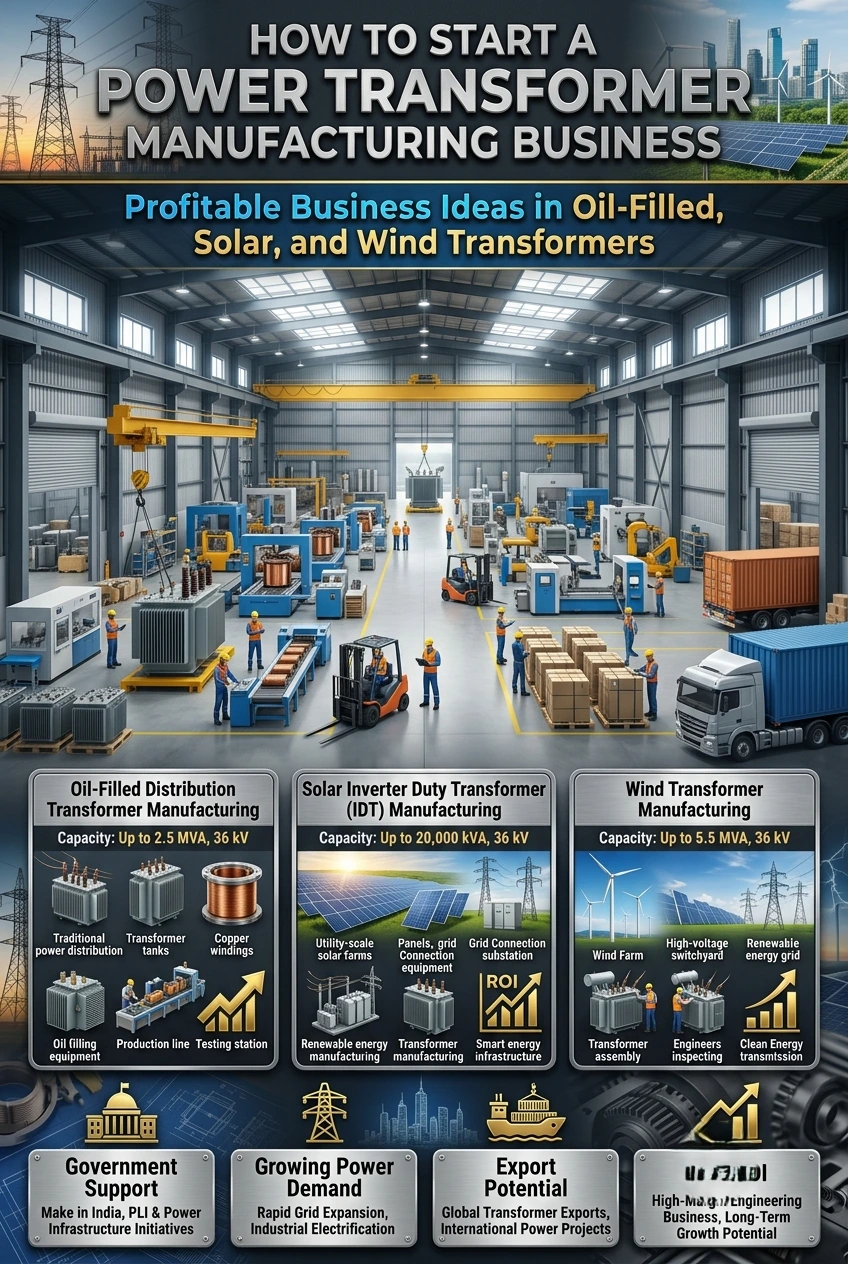
Business Idea 3: Wind Transformer Manufacturing (Up to 5.5 MVA, 36 kV)
The wind transformers market is highly specialised and niche in the power transformer market. For small wind turbines, a transformer (typically called a step-up transformer) sits at or near the base of the wind turbine tower and increases the voltage from the turbine before supplying power to the grid. For small wind turbines (with power ratings below 1.5 MW), manufacturers often use step-up transformers called pad-mount or dry-type transformers, while larger turbines typically use oil-filled transformers. The wind power has an extreme duty cycle: The load on the transformer is constantly changing due to the wind’s intermittent nature, the vibration of the wind turbine structure, and in some cases, the severe environment in which the load is operating, such as humidity, dust, and temperature extremes.
The wind energy industry is now in a new growth stage in India. Specifically, the offshore wind program, the repowering of existing wind farms with more powerful turbines, and new wind projects onshore in high-wind states, such as Gujarat, Tamil Nadu, Rajasthan, and Karnataka, create a sturdy and long-lasting demand pipeline. All the top OEMs for wind turbines, including Siemens Gamesa, Vestas, GE Vernona, Inox Wind and Suzlon, are procuring transformers either by themselves or through their supply chain partners. Access to this supply chain is not without technical access, quality audits and sometimes requires a type-test certificate from an accredited lab.
Get Detailed Insights from This Book: Solar PV Power and Solar Products Handbook
A dedicated Wind Transformer manufacturing plant ranging from 1.5MVA to 5.5MVA would need investments in the range of ₹4 crore to ₹7 crore, apart from enhanced testing capabilities. But the monetary benefits are commensurate. The contracts for wind OEMs are far superior than DISCOM spot market tenders in terms of revenue certainty, typically 1–3-year contracts with quarterly delivery schedules. This is one of the most viable and scalable manufacturing ideas in the electrical equipment industry for a well-prepared MSME who has the required engineering skills.
Import–Export Opportunity Analysis for New Startups
At present, India is importing power transformers, particularly high voltage, high-capacity power transformers from China, South Korea and Germany. Repeatedly, imports from the Directorate General of Foreign Trade (DGFT) indicate high levels of transformer imports in the 33 kV and above category. Data from the Directorate General of Foreign Trade (DGFT) also reveals that the quantity of transformers imported into the country in the 33 kV and above category is substantial. This is a local import substitution project. With proper targeting and marketing to EPCs and utilities, a startup who is able to manufacture products to BIS and IEC standards and offer competitive prices can compete with a substantial percentage of such imports.
The opportunity, on the export side, is even more textured. African countries that are rural electrifying are rolling out distribution transformers at scale, with support from the World Bank and African Development Bank, in Kenya, Ethiopia, Tanzania and Uganda. Indian manufacturers who are able to produce goods that are compliant with IEC 60076, have test reports from NABL-accredited laboratories and have a competitive price have secured a large number of contracts in these markets. Southeast Asia, especially Bangladesh, Nepal and Vietnam is another emerging corridor for Indian transformer exports.(Power Transformer Manufacturing Business)
Also, the Middle East is transitioning towards renewable energy, especially in the Kingdom of Saudi Arabia and the United Arab Emirates, creating demand for solar IDTs and equipment. Renewable energy transformer projects are starting to capture the attention of Indian manufacturers with experience in renewable energy. If a startup establishes quality credentials at an early stage and commits to export marketing, they can achieve 20–30% export revenue share within 3–4 years, which gives them strong export market resilience and will enhance the credit rating of their business.
Indian MSME Success Stories in Power Transformer Manufacturing
Voltamp Transformers: The MSME That Became a Benchmark
Any new entrant to this sector can learn from the success story of Voltamp Transformers Limited, which the Sanghvi family from Vadodara, Gujarat, founded. The MSME started as a supplier of distribution transformers in Gujarat, and transformed into a listed company with a significant portfolio in industrial and renewable energy products. A major lesson is the promoters’ discipline in sticking to a narrow product focus, which is the ability to stay away from the temptation to scale too much to very large power transformers too soon.
Voltamp gained a strong presence in the market from 1 MVA to 10 MVA and emerged as the preferred supplier for a large customer base of industries and infrastructure. The business proved that knowing a lot about a relatively narrow product band is more enduring than knowing a wide variety of products without engineering foundations.
Shilchar Technologies: Renewable Energy Pivot as a Growth Strategy
Shilchar Technologies, based in Anand, Gujarat, offers a compelling example of a transformer manufacturer that successfully pivoted to renewable energy applications. The company identified the inverter duty transformer opportunity early and built product development and testing capabilities specifically for solar applications. As the solar sector expanded, Shilchar’s order book grew disproportionately because it had the right technical approvals in place. The lesson here is timing and preparation — the manufacturers who invested in solar IDT capabilities before the market peaked captured the best margins. For a new entrepreneur, this signals that positioning for tomorrow’s demand cycle — in this case, offshore wind and green hydrogen — while serving today’s market is the right strategic framework.(Power Transformer Manufacturing Business)
Indo Tech Transformers: South India’s Regional Champion
Indo Tech Transformers, a Chennai-based manufacturer, demonstrates how regional market focus combined with BIS and IEC compliance can build a durable business. The company serves Tamil Nadu and neighbouring state utilities while also participating in renewable energy transformer supply. The company built its success through tight quality control, faster delivery cycles than larger national competitors, and responsive after-sales service — advantages that any well-run MSME can realistically replicate across India. New entrepreneurs should note that regional DISCOM relationships, built carefully over years, provide stable base revenues on which to layer the higher-margin renewable energy business.
Related Article: Best Power Transmission Business Opportunities in India: India’s ₹5–6 Lakh Crore Power Transmission Boom: 6 Business Opportunities
How Professional Feasibility Analysis Helps Before You Invest
Setting up a power transformer manufacturing facility involves significant capital decisions — plant location, equipment selection, product range definition, raw material sourcing strategy, and customer targeting. Getting any of these wrong in the early stages can compromise the unit’s economics for years. This is precisely where detailed pre-investment analysis adds measurable value.
At Niir Project Consultancy Services (NPCS), we provide professional consulting for the preparation of Market Survey cum Detailed Techno-Economic Feasibility Reports (DPRs) for setting up new manufacturing businesses including power transformer plants. Our reports cover the complete manufacturing process with flow diagrams, demand and market analysis, product mix and capacity planning, detailed machinery and raw material specifications, plant layout design, and complete financial projections including profitability analysis, IRR, and payback period calculations.(Power Transformer Manufacturing Business)
Our objective is to equip entrepreneurs with the analytical foundation to evaluate feasibility and long-term scalability before committing capital. For a sector like power transformers — where the technical requirements, procurement strategy, and market positioning all significantly affect financial outcomes — a structured DPR is not an optional exercise. It is the difference between entering the market with confidence and discovering critical gaps after the plant is already built.
Market and Project Data at a Glance
The table below provides indicative data on the three primary business lines covered in this article. These figures are intended as planning benchmarks and should be validated through a detailed techno-economic feasibility study before investment decisions are made.
| Parameter | Oil-Filled Distribution Transformer | Solar Inverter Duty Transformer (IDT) | Wind Transformer |
| Product Range | Up to 2.5 MVA, 36 kV | Up to 20,000 kVA, 36 kV | Up to 5.5 MVA, 36 kV |
| BIS / IEC Standard | IS 1180, IS 2026, IEC 60076 | IEC 60076 + K-Factor de-rating | IEC 60076, IEC 60815 |
| Estimated Plant Investment | ₹2.5 Cr – ₹4 Cr | ₹3.5 Cr – ₹6 Cr | ₹4 Cr – ₹7 Cr |
| Approx. Plant Area Required | 10,000 – 15,000 sq ft | 12,000 – 18,000 sq ft | 12,000 – 20,000 sq ft |
| Primary Customers | DISCOMs, Industrial estates | Solar EPC contractors, IPPs | Wind OEMs, IPPs |
| Estimated EBITDA Margin | 12% – 18% | 15% – 22% | 16% – 24% |
| Key Raw Materials | CRGO steel, Copper, Transformer oil | CRGO steel, Copper, Low-loss core | CRGO steel, Copper, Special insulation |
| Export Market Potential | Africa, South Asia | Middle East, Southeast Asia | Europe, Africa |
| Payback Period (Indicative) | 4 – 6 years | 4 – 5 years | 4 – 6 years |
| Workforce Required (Initial) | 40 – 70 personnel | 50 – 80 personnel | 50 – 90 personnel |
Frequently Asked Questions
Q1. What is the minimum investment required to start a power transformer manufacturing unit in India?
Normally, a modest- sized oil filled distribution transformer plant’s min viable investment is approximately as between 2.50 crore & 4.00 crore which include land development/Lease, CIVIL works, core and its cutting, winding machines/tank fabricated, VACUUM OIL FILLING PLANT, HIGH VOLTAGE testing equipment and working capital. Solar IDT and wind transformer plants may require ₹3.5 crore to ₹7 crore depending on the rating range and testing capability targeted.
Q2. Do I need BIS certification to sell transformers to Indian utilities?
Yes. State Electricity Boards (SEBs) and DISCOMs require distribution transformers to obtain certification as per IS 1180 (for oil-immersed transformers up to 2500 kVA) and IS 2026 before they supply them. Without BIS certification, a manufacturer cannot participate in government tenders. The certification process involves product type testing at a BIS-recognised laboratory and a factory inspection. New manufacturers should budget 6–9 months and ₹8–15 lakh for this process depending on product range.
Q3. What are the key raw materials, and how should a new manufacturer manage material costs?
Inputs Most important raw material components: Cold Rolled Grain Oriented (CRGO) silicon steel lamination (approx. 25 to 30% of a transformer’s costs), copper winding wire (20-25%), oil (10-12%), pressed board insulation, steel tank and fittings. CRGO steel – the most critical and volatile commodity, made by SAIL, or sourced from imports (Japan- JFE, Nippon Steel, South Korea – POSCO, Germany). Most mature players hedge copper exposure at the time of booking the project to lock costs, instead of buying when it’s delivered.
Q4. How long does it typically take to set up a transformer manufacturing plant and begin commercial production?
From project inception to first commercial supply: 18-24 months (site selection and civil works – 6-8 months, machinery acquisition & commissioning – 4-6 months, BIS testing & certification – 6-9 months (can be concurrent), recruitment & process qualification – 3-4 months). Strict project control and an early start of the BIS certification process help achieve the shortest project duration.
Q5. Can a new transformer manufacturer realistically compete against established companies like ABB, Siemens, or Crompton Greaves?
Forcing directly compete in big tenders with Tier-1 global Brands isn’t feasible entry-level strategy for MSME’s. However, the market is genuinely segmented. DISCOMs source large volumes of distribution transformers from hundreds of registered vendors including MSMEs, and regional utilities often prefer local suppliers for faster delivery and service. Solar EPCs looking for trustworthy IDT manufacturers prefer to work with mid-sized players as against big global concerns. A new firm, focused on a narrower range, meeting BIS standards, with an ISO certification and, critically, with rapport in with regional utility procurement will be in a position to achieve moderate growth without getting into a slugfest with multinational.
Q6. What government schemes can help finance a new transformer manufacturing unit?
Several schemes are relevant. What are the benefits in form of various schemes provided to the MSME: CGTMSE scheme is provided by Ministry of MSME through banks/institutions giving collateral free loans up to Rs. 5 crore PMEGP scheme: This is another major scheme aimed at giving of 15-35% capital subsidy for manufacturing starts up. State Government industrial investment subsidy schemes: Apart from this most of the State Governments give subsidy on eligible capital expenditure (10% to 25%). Term loans for plant and machinery are available from SIDBI and scheduled commercial banks under MSME-priority lending norms. An entrepreneur should engage with the District Industries Centre (DIC) of the target state early to map available scheme benefits.
Conclusion: A Sector That Rewards Preparation
Power transformer manufacturing is not a business that rewards impulsive entry. It rewards preparation — in engineering capability, quality systems, procurement strategy, and market positioning. However, for entrepreneurs willing to invest that preparation, the sector offers durable demand, strong policy support, and real competitive space for well-run MSMEs.
This article explores three transformer manufacturing opportunities: oil-filled distribution transformers, solar inverter-duty transformers, and wind transformers. Together, these segments support India’s current and future power infrastructure needs.
Entrepreneurs can build a profitable and scalable manufacturing business by selecting the right segment. They should also develop a skilled technical team, obtain the required certifications, and target suitable customers. With the right strategy, the business can grow significantly within a few years of launch.
India’s energy transition is not a theme — it is an engineering procurement programme happening at national scale. Power transformers are at its core. The businesses that position themselves correctly today will be supplying to a market that only grows larger for the next two decades.
References and Further Reading
- Ministry of MSME – Schemes and Incentives
- DPIIT – Make in India Initiative
- DGFT – Export Import Policy
- EEPC India – Engineering Export Promotion Council
- Ministry of Heavy Industries – Capital Goods Schemes
- EPCES – Export Promotion Council for EOUs and SEZs