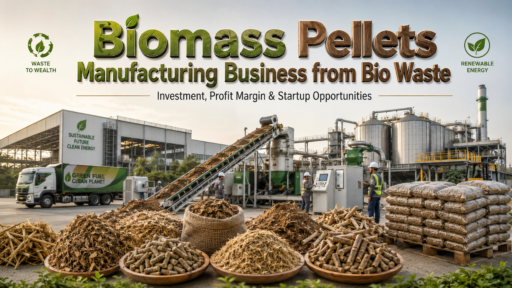
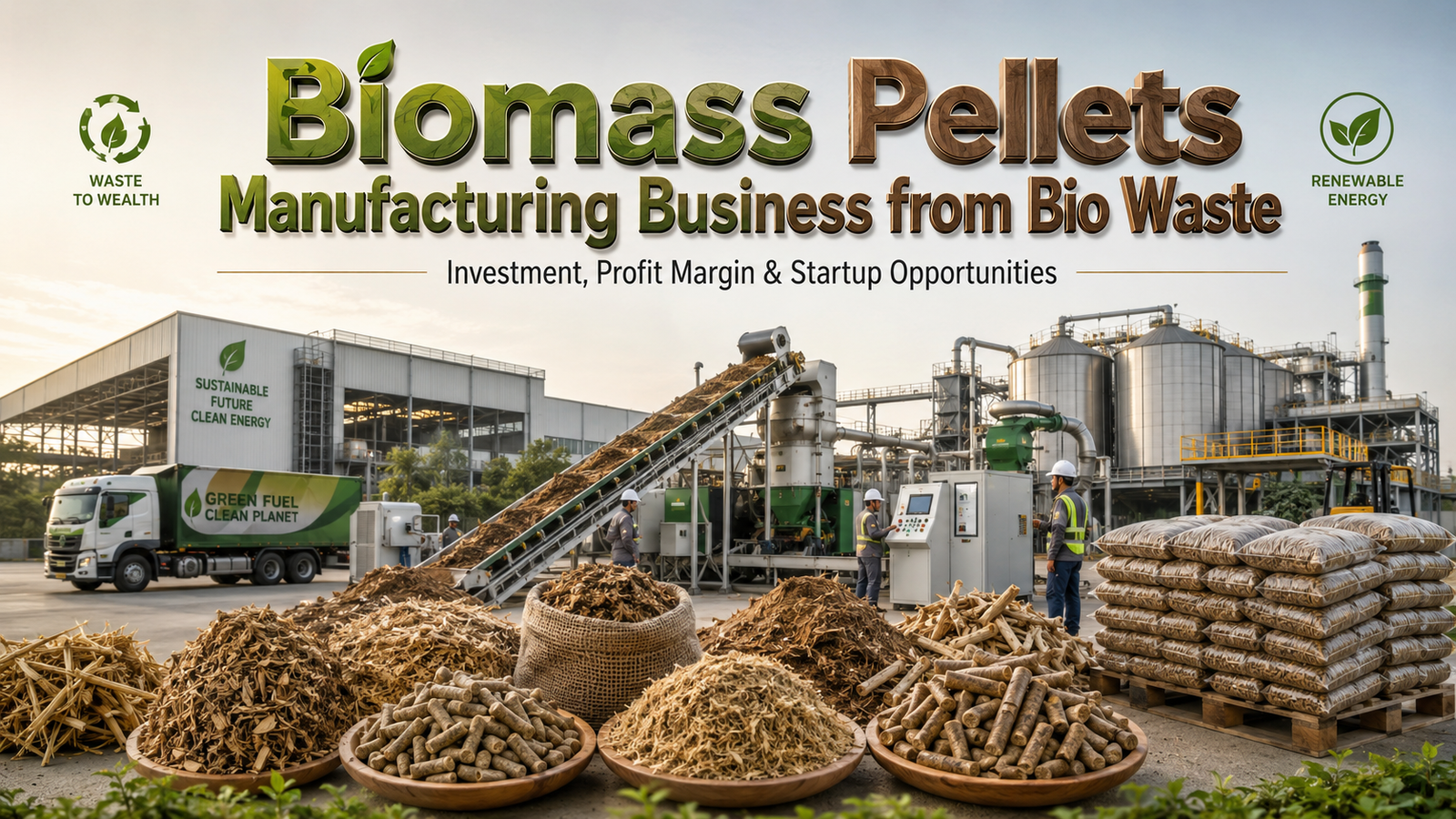

Biomass Pellets Manufacturing Business
If you are looking for serious business ideas in biomass energy and agro-industrial, then immediately biomass pellet manufacturing is not to be overlooked. In India, farmers and industries produce huge amounts of agricultural waste every year, including paddy straw, sugarcane bagasse, cotton stalks, mustard husks, sawdust, and municipal organic waste, and people either let a significant portion of this waste decompose in fields or burn it in open spaces. At the same time, a powerful cohort of businesspeople is turning these inexpensive waste streams into high-value energy pellets and exporting them to other countries. Economics are strong, supply is plentiful and inexpensive, and the regulatory climate has never been more favorable. Biomass pellets offer a true and scalable business opportunity where any entrepreneur who has the inclination to think out of the box and invest properly can reap multi-crore revenues.
Get Detailed Insights from This Book: Handbook on Agro Based Industries (3rd Edition)
Why Biomass Pellets? The Market Logic That Drives the Business
Structural and persistent demand for biomass-based solid fuels has been driven by the global transition towards decarbonization. Countries such as the UK, Japan, South Korea, and several European nations have strict renewable energy targets. To help meet these goals, they purchase millions of tonnes of wood and agricultural pellets each year to fuel power stations and industrial heaters. India, being a country with a huge biomass surplus is naturally poised at the supply end of this equation. Internally, the situation is also looking bright – the Government of India’s National Bioenergy Programmed is aimed at generating more than 10 GW of biomass-based electricity, and various industrial consumers are keen to replace furnace oil and coal with biomass pellets for both regulatory and cost considerations.(Biomass Pellets Manufacturing Business)
On the demand end, there are really no raw materials available. Punjab, Haryana, Uttar Pradesh, Maharashtra, Andhra Pradesh, Karnataka and other states in the country generate tens of million tonnes of Agri-residue every year. The farmer is willing to sell the waste at INR 800-1,500 tonne, finished pellets are sold in domestic market at INR 5,000-8,000 tonne and in export market at USD 120-200 tonne. That’s a gross margin structure that most manufacturing companies would be jealous of. A golden rule for any business based on commodity, is that it must be operated with strict discipline, consistent feedstocks and good market linkages.
Government Policies and Incentive Landscape
Indian policy framework for production of biomass pellets is wide and liberal. Various biomass-based projects can receive capital subsidies from the Ministry of New and Renewable Energy under the National Bioenergy Programmer, typically covering 25–35% of the total project cost. Small and medium manufacturer can also avail of the
The Credit Guarantee Fund Trust for Micro and Small Enterprises (CGTMSE), through the Ministry of MSME, to avail collateral-free working capital loans of up to INR 5 crore under MSME Technology Upgradation Scheme.
Although primarily focused on solar energy, the PM-Kisan Urja Suraksha evam Utthaan Mahabhiyan (PM-KUSUM) scheme also includes provisions that overlap with biomass energy projects in rural clusters. The Startup India platform, administered by DPIIT, offers tax exemptions under Section 80-IAC, a self-certification mechanism, and faster environmental clearances for biomass processing units. These measures reduce bureaucratic hurdles and support startups in establishing and expanding their operations. In addition, export-oriented biomass pellet units can benefit from the Make in India initiative. These benefits include reduced import duties on capital machinery under the Export Promotion Capital Goods (EPCG) scheme.(Biomass Pellets Manufacturing Business)
For people working in the rural belts,
Cooperative and rural banks can avail refinancing facility through National Bank for Agriculture and Rural Development (NABARD) under Rural Infrastructure Development Fund (RIDF) with very concessional interest rates. Many State Governments also implement their own state-level biomass policies and offer additional incentives, including allotting land at subsidized rates in agro-industrial parks, particularly in Punjab, Uttar Pradesh, Karnataka, and Maharashtra.
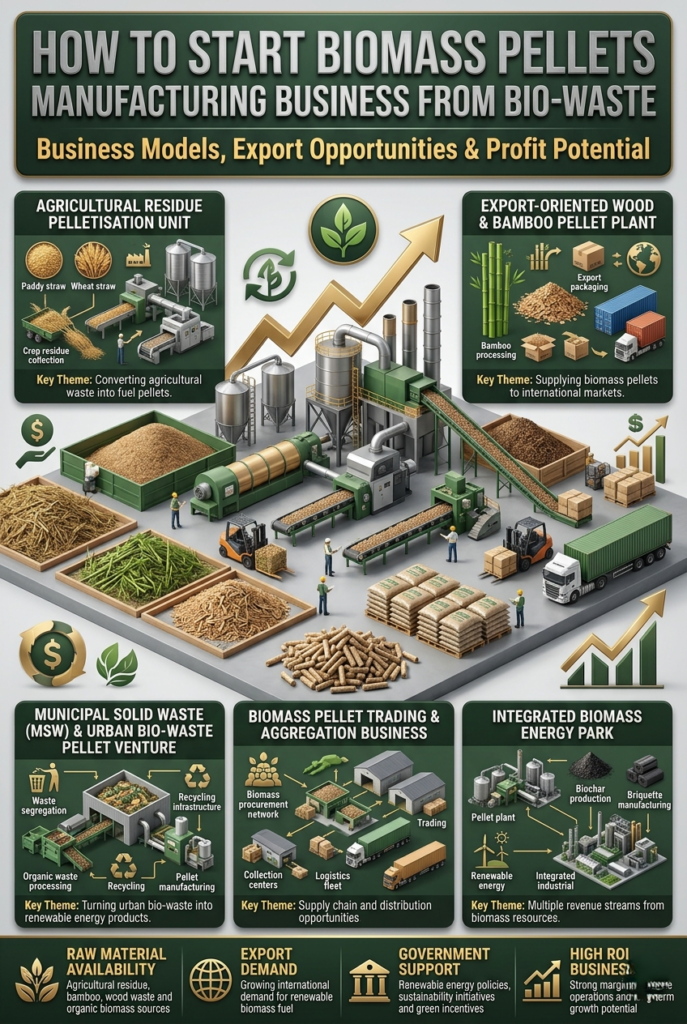
Multiple Business Ideas Within Biomass Pellet Manufacturing
1. Agricultural Residue Pelletisation Unit
The most direct way to enter this sector is by setting up a dedicated pelletisation unit. Such a unit processes agricultural residues such as paddy straw, wheat husk, cotton stalks, and maize cobs into standardized biomass pellets with a diameter of 6–10 mm. The estimated investment for a small-scale plant with a capacity of 2–5 tonnes per hour (TPH) ranges from INR 25–50 lakh. This includes machinery, land preparation, and working capital requirements. The business model is straightforward.
Entrepreneurs procure crop residues from local aggregators or directly from farmers after harvest. The biomass is then dried to a moisture content below 12%, pelletized, packaged, and dispatched to customers. Profitability improves significantly when entrepreneurs secure offtake agreements with industrial boiler operators, such as textile mills or brick kilns, before commissioning the plant. A 3 TPH unit operating for 20 days per month can generate annual revenue of approximately INR 90 lakh to INR 1.2 crore. Once operations stabilize, EBITDA margins can reach 30–40%.(Biomass Pellets Manufacturing Business)
2. Export-Oriented Wood and Bamboo Pellet Plant
An export-oriented pellet plant is a lucrative business opportunity for entrepreneurs with access to forest residues, sawmill waste, bamboo clippings, and plantation wood chips. European importers, in particular, require ENplus or ISO 17225-2 certified wood pellets. These certifications are required under the EU Renewable Energy Directive (RED III).
For a 5–10 TPH plant, the project cost typically ranges from INR 1.5–3 crore. Additional investment is needed for advanced quality control systems, including a NIR moisture analyzer and laboratory equipment. Stronger return usually compensates for a higher investment. Export selling prices are much higher than domestic selling prices. Letters of credit or down payment can be available from international buyers which would be beneficial for managing working capital.
Entrepreneurs from Odisha, Chhattisgarh, the Northeast and Uttarakhand may benefit greatly from the described business model. This part of India is rich with wood-based industrial wastes, etc. And biomass feedstocks available for the purpose.
3. Municipal Solid Waste (MSW) and Urban Bio-Waste Pellet Venture
There is immense pressure to manage organic waste in the Tier I and Tier II city municipal corporations in India. Experts view the RDF producer partnership model as a sustainable solution for managing organic waste. Urban Local Bodies (ULBs) and RDF producers have developed institutional support for the RDF producer partnership model. Markets, food-processing parks, and hotels segregate organic waste and process it into RDF pellets, which they can then co-fire in power plants and cement kilns. The calorific value of the RDF pellets is usually 3000-4500 kcal/kg.
Positive government policies and directives from the NGT and CPCB also support the model and encourage the adoption of RDF. In the RDF generation model there are two sources of income to producers, (i) tipping fees or gate fees by municipalities and (ii) sale of RDF pellets to industrial consumers.
This business suits stakeholders with experience in municipal contracting, transportation and logistics, or the solid waste management industry.
4. Biomass Pellet Trading and Aggregation Business
Not all business owners have to own a manufacturing facility. An asset light option is to establish a biomass pellet trading and aggregation business that is based on aggregating, quality control, re-branding and supplying pellets from various small-scale producers in rural areas to institutional buyers. The added value here is the quality standardization, logistics dependability, and commercial terms negotiation. With a lower initial investment requirement of INR 10–20 lakh required for warehousing, testing equipment and working capital, there is a need for robust commercial relationships on both the supply and demand side of the model. Early adopters of quality certification such as BIS Standards and Green India Certification should be able to enjoy a preferential advantage in accessing the export broker and international traders who seek reliable export operations from within India.
Get Detailed Project Report (DPR): Biomass Pellets from Bio Waste
5. Integrated Biomass Energy Park (Co-Located Pellet + Biochar + Briquette)
An integrated biomass energy park which utilizes the raw material stream for producing pellets, biochar and biomass briquettes simultaneously can massively enhance resource utilization and revenue diversification for entrepreneurs with an appetite of higher capital investment (INR 3 – 5 crore). The carbon-rich by-product of biomass torrefaction or slow pyrolysis is biochar. It fetches high market prices in agricultural soil amendment markets and in carbon sequestration markets.
Biomass briquettes are denser and cheaper to produce. Different industrial sectors use them, including small boiler operations, dhoop stick manufacturers, and cremation grounds. The entrepreneur has a near zero waste business, a variety of buyers, and a diversified risk model as they produce all three utilizing the same bio-waste feedstock. This is also bolstering the case for the unit to be eligible for carbon credits under India’s fledgling domestic carbon market.(Biomass Pellets Manufacturing Business)
Import–Export Opportunity Analysis
India’s biomass pellet export journey is truly at a turning point. Sustainable solid biomass remains in structural undersupply because the EU has binding renewable energy targets and countries such as Germany, the Netherlands, Belgium, and Denmark are gradually phasing out coal-fired heating. India’s relatively low-cost agriculture residue base and huge pellet production potential make it a potential second source of supply, in addition to the supplies from North America and Southeast Asian countries. Exporters who aim to reach this corridor should invest in quality certification (ENplus A1/A2 for industrial grade pellets) and phytosanitary compliance and in standardised 25 kg or 1 tonne big-bag packaging.
Top quality biomass processing machinery-such as flat die pellet mills, ring die pellet mills, hammer mills, rotary drum dryers, moisture controls-are all imported. The sources are Germany, China and Italy. The EPCG Scheme offers exemption of import duties on the capital machinery for those enterprises catering to export markets. This lowers the capital costs. Additionally, entrepreneurs should consider looking into other options.
All of this can help biomass pellet exporters build their credibility in new geographies by coming under the ambit of market development assistance and export credit support by APEDA (Agricultural and Processed Food Products Export Development Authority) under the Ministry of Commerce and participation in International Trade Fairs.
Indian MSME Success Stories in Biomass Energy
Husk Power Systems — Manoj Sinha, Gyanesh Pandey
Founded in rural Bihar, the birthplace of Husk Power Systems, limited availability of dependable energy was its motivation. Husk Power Systems’ innovation lies in its distributed biomass gasification model for village electrification. The company founded itself on the conviction that agricultural waste is not waste but an energy source and an opportunity—this concept still drives the pellet industry today. It also shows that smart use of capital builds efficiency. Rather than invest in the establishment of a supply chain, the company used the existing supply chain based in the rural communities. It led to lower capital costs and increased speed to growth. Since then, Husk Power Systems has grown globally and attracted foreign investment. The company proves that the biomass based business if it can sustain on a good local feedstock economics can attract institutional investment.
Aryan Coal Beneficiation — Transition to Biomass Blending
As thermal power plants increasingly adopt co-firing of biomass with coal under the directives of CERC and BEE, several industrial coal traders from Nagpur, Raipur, and Kolkata are carrying out a covert operation in which they blend biomass pellets with coal and supply them to the plants. These businessmen were able to use the existing logistics structure, their relationships with buyers and their handling equipment to get in to the biomass sector with a low incremental cost. The message from the lesson for newcomers is obvious: biomass pellets are not an alternative to industrial fuel supply, commodities logistics or agri-trade, but rather an opportunity to re-position.(Biomass Pellets Manufacturing Business)
Turn your budget into a successful business plan
Enviro Control Associates — MSW to Fuel Model
The Gujarat-based company’s repute is for converting municipal and industrial bio-waste into refuse derived fuel (RDF) pellets and supplying the same to the cement plants in western India. The company first developed its plant infrastructure and then secured long-term municipal waste processing contracts. This approach was driven by market demand and helped reduce business risk. The best takeaway for the new entrepreneur is that institutional buyers, such as cement companies, paper mills, and power plants, will consider entering forward supply contracts in exchange for the manufacturer’s quality and reliability. The contract-first, plant-second approach makes projects bankable and lender-ready.
About NPCS — Turning Business Ambition into Bankable Feasibility
Entrepreneurs who are truly committed to establishing biomass pellet manufacturing businesses often experience an agonizingly long path from initial interest to making a financial commitment. This is precisely where Niir Project Consultancy Services (NPCS) steps in to lend value to the process. NPCS designs comprehensive Market Survey cum Detailed Techno-Economic Feasibility Reports (DPRs) for the establishment of new ventures and industrial processes. Our DPRs comprehensively deal with every aspect of a project, from process diagrams and manufacturing procedures to individual machine capacity and machinery selection, supply chain and raw material procurement, with complete cost, financial, cash flow, revenue, profit and return estimations.
For biomass pellet businesses, NPCS’ feasibility studies will include analysis of feedstock available, calorific value of fuel, list of suitable machinery suppliers, analysis of export opportunities etc., to assist bank-financed entrepreneurs and other investors make a well-informed decision. NPCS helps founders assess the viability, profit potential, and long-term scalability of their business before they invest any monetary resources. For interested parties seeking the latest information regarding the bioenergy sector and governmental assistance policies, Ministry of New and Renewable Energy (MNRE)) publications like biopower policies, scheme details and reports are a critical first reference source.
Related Article: Profitable Biomass Pellet Business: Non-Torrefied & Torrefied Pellets
Key Project & Market Data — Biomass Pellet Manufacturing in India
| Parameter | Details / Estimated Figures |
| Global Biomass Pellet Market Size | USD 12+ Billion (rapidly growing) |
| India Biomass Energy Potential | ~500 Million Tonnes of bio-waste annually |
| Average Pellet Plant Setup Cost (Small) | INR 25 – 50 Lakhs (2–5 TPH capacity) |
| Average Pellet Plant Setup Cost (Medium) | INR 1 – 3 Crores (5–15 TPH capacity) |
| Raw Material Cost (Agri Waste) | INR 800 – 1,500 per tonne |
| Selling Price of Biomass Pellets (Domestic) | INR 5,000 – 8,000 per tonne |
| Selling Price of Biomass Pellets (Export) | USD 120 – 200 per tonne |
| Gross Margin Potential | 35% – 55% depending on feedstock and scale |
| Key Export Markets | Europe (EU), Japan, South Korea, UK |
| Break-Even Period (Small Plant) | 18 – 30 months |
| Government Subsidy (MNRE/MSME Schemes) | Up to 25–35% capital subsidy available |
| Employment Generation (Per Plant) | 15–40 direct jobs; 100+ indirect |
Note: Figures above are indicative and based on current industry benchmarks. Actual project economics vary by feedstock type, plant location, scale, and technology selected. Entrepreneurs should commission a formal feasibility study for site-specific projections.
Useful Reference Links for Entrepreneurs
Bureau of Energy Efficiency (BEE) — Biomass Co-Firing Guidelines: https://beeindia.gov.in
Make in India — Industrial Promotion Portal: https://www.makeinindia.com
DPIIT — Startup India for New Entrepreneurs: https://www.startupindia.gov.in
FAQs
1. Will I make money manufacturing biomass pellets in India?
Yes. Depending upon the cost of feedstock, plant efficiencies and access to market, the biomass pellets business can show gross margins in the range of 35%-55%.
2. How much investment would be required to set up a biomass pellet manufacturing plant?
Between 15-30 lakhs for small plant, and 40 lakhs -3 crores for medium & large-scale plant.
3. Which is the best feedstock to manufacture biomass pellets?
People widely use paddy straw, rice husk, sugarcane bagasse, sawdust, wheat straw, bamboo waste, cotton stalk, etc.
4. Are biomass pellets exportable from India?
Yes. The biggest consumers of biomass pellets (Europe, Japan, South Korea & UK) buy from international sellers.
5. What is the selling price of biomass pellets?
This price can range from around 5000-8000 Rs/tonnes for Indian consumption and $120-200/tonnes for exports.
6. Are there any government subsidies offered for setting up a biomass pellet plant?
There could be subventions under MNRE schemes, MSME schemes, NABARD etc.
7. How long will it take to set up a biomass pellet plant?
Overall time to most of the small/medium scale biomass plants would be 6-9 months post approval and funding.(Biomass Pellets Manufacturing Business)
8. Which are the major clients/users of biomass pellets?
Major users include power plants, textile industries, paper mills, food processors, brick kilns & ceramic companies.
9. What is the biggest challenge in this business?
Making available consistent quality biomass feedstocks at reasonable rates is often considered as the greatest operational challenge.
10. Is this a future-proof business?
As reliance on renewables increases and environment rules get stringent, the popularity of biomass pellets as a fuel is expected to be stable for many years to come.