How India’s ₹5,000-Plant CBG Ambition Hinges on Agricultural Waste Supply Chains — and Why Entrepreneurs Should Move Now
Though India has sanctioned over 1000 Letters of Intent for Compressed Biogas (CBG) plants under the SATAT scheme, only roughly 108 plants have been commissioned so far when the government’s target is 5,000. It’s not money, it’s not policy, it’s not technology. The sourcing of feedstocks is the next major lever to scale India’s CBG ecosystem, according to a detailed report highlighted by The Hindu.
The message for entrepreneurs and MSMEs is clear – the CBG value chain is not all about establishing a plant. It’s not making a business of that plant; it’s making a business of the year-round reliable biomass supply chain. That’s the chain where the next wave of business opportunities is to be found: in biomass aggregation, digital feedstock mapping, pre-treatment processing, farmer linked logistics and value-added by-products.
As The Hindu’s industry coverage shows, the race is already on to find out the agricultural residues such as paddy straw, cotton stalks, sugarcane trash, press mud, and others. The people who establish this supply chains now will shape the future of this industry for the next ten years.
What the Feedstock Crisis Means for India’s CBG Sector
The Ministry of Petroleum and Natural Gas has launched the SATAT scheme for 5,000 CBG plants in the country in October 2018. Procurment price, from Oil Marketing Companies (OMCs) like IOCL, BPCL and HPCL at ₹46-72 per kg looks attractive. The annual revenues from gas production alone for a 10 TPD plant (600-2,000 kg CBG/day) are in the range of ₹1.5 – 2 crore, and there is a potential of extra revenue of bio-slurry fertiliser.
But the commissioning gap says a lot of a story. By the end of July 2025, industry experts had issued over 1,094 Letters of Intent (LoIs), but companies had commissioned just 108 plants. One common denominator that industry experts pointed out, including those who spoke at the Renewable Watch ‘Compressed Biogas in India’ conference, was that “feedstock supply chains are more complex and fragile than the industry thought.
Agricultural residues are non-continuous. Paddy straw can only be harvested at harvest time. In some localities, sugarcane trash builds up. For bulky, low-density biomass, the economics of transportation are more complicated than 50 km. Competing buyers, such as brick kilns, paper mills and biomass power plants, regularly out-bid CBG developers at crucial junctures.
The business opportunity is here! Each concern across the feedstock value chain is a start-up opportunity, an MSME contract and an investment thesis.
Why the CBG Industry Is Growing — and Why Feedstock Is the Turning Point
This is the time when India’s CBG sector has reached a turning point. CBG blending has been mandated by the Petroleum and Natural Gas Regulatory Board (PNGRB) for the supply of CNG/PNG: 1% for FY 2025-26, increasing to 3% for FY 2026-27, 4% for FY 2027-28 and 5% for FY 2028-29 and thereafter. This is no longer a free market. It is a mandate which has been legally backed and it is compliance driven.
With the introduction of a voluntary SATAT-based model to a statutory CBG Blending Obligation (CBO) framework, there is now a guaranteed demand for these services. The city gas distribution (CGD) licensees are required to acquire CBG irrespective of the volatility in prices. It eliminates any risk on the offtake side of the business.
The focus now is on supply and that is feedstock. According to industry estimates, India produces over 500 million tonnes of agricultural residue every year or so. Paddy straw makes up 60 million tonnes of which 90% is burnt in the field with enormous environmental cost. Sugarcane trash, maize stover, cotton stalks, press mud, municipal solid waste, and even non-traditional residues, such as chilli waste, mango seeds and turmeric residue, are making their presence in CBG supply chains.
The feedstock economy is vast, unorganized, and ripe for professionalization for MSMEs and entrepreneurs. The growth of the CBG sector will depend on who can establish the most secure biomass supply chains and those in the right will reap the rewards.
Government Policies and Incentives Supporting the CBG Feedstock Ecosystem
The Ministry of Petroleum and Natural Gas (MoPNG) operates the SATAT scheme, under which OMCs enter into 15-year offtake agreements with CBG producers at a notified price. Commercial gateway to a bankable CBG business is the LoI process through the SATAT portal (iocletenders.nic.in).
The Ministry of New and Renewable Energy (MNRE) offers capital subsidy under National Bioenergy Programme and biomass aggregation machinery (BAM) under the scheme GOBARdhan. The BAM subsidy directly lowers the costs for collection, compression, and transportation of agricultural residues and enables businesses to aggregate feedstocks on a smaller scale.
The Department for Promotion of Industry and Internal Trade (DPIIT) promotes manufacturing investments through the Production Linked Incentive (PLI) schemes. There are several PLI categories for CBG-related equipment manufacturing, including anaerobic digesters, gas purification systems, compression units, etc.
Credit guarantee support is provided by Ministry of MSME through CGTMSE for investments of up to ₹2 crore without any collateral and directly supports small scale biomass aggregation startups and the feedstock pre-treatment units. The RBI has also classified CBG projects under the priority sector category, making it much easier to access finance from banks.
Chhattisgarh Biofuel Development Authority (CBDA): It is a model State Authority and provides a one-stop solution to investors for site identification, feedstock mapping and regulatory approvals for CBG. Some states, such as Punjab, Uttar Pradesh, Rajasthan and Haryana are showing signs of facilitating at state level, which are all major agricultural residue producing states.
Invest India is a platform that facilitates investment across various sectors and Startup India (DPIIT) offers recognition, fund-of-funds, and regulatory sandboxing for early-stage bioenergy projects.
Manufacturing Business Ideas Emerging From the CBG Feedstock Gap
1. Biomass Aggregation and Pre-Treatment Processing Units
The main deterrent to the CBG sector is not the technology of biogas production, it is the availability of organised, consistent and pre-processed biomass to the plant gate at cost predictable. This will make the setting up of regional biomass aggregation hubs a clear manufacturing and services business. They collect the paddy straw, cotton stalks, maize stover, and other residues from farm clusters within 50 km of the CBG plants and bale, dry, chip, or pelletise the residues so they can deliver them to the plants.
The medium scale aggregation hub with baling and chipping facility requires capital ranging from ₹ 50 lakh to ₹ 2 crore. Revenue can come from long-term supply agreements with CBG developers at Rs1500-3000 per tonne of processed biomass. The MNRE subsidy for BAM will substantially reduce equipment costs. The MSME CGTMSE scheme provides loans of up to ₹2 crore with a 0% collateral requirement, making it an attractive choice for agri-entrepreneurs and rural MSMEs.
Get Detailed Project Report (DPR): Biomass, Biofuel & Energy Development Projects
2. Biomass Pelletisation and Torrefaction Manufacturing
The bulk density of raw agricultural residues are low, so transportation over long distances is not economical. By converting biomass into pellets or torrefied briquettes, this process improves energy density, reduces transport costs, and allows biomass to be stored and transported over distances of more than 150 km. This significantly increases the catchment area for CBG plants. The investment in a pelletisation plant with capacity of 10-20 tonnes per day of agricultural residue is ₹30-₹80 lakh for buying the pelletising machines, dryers and storage. The standardised biomass pellets can be sold to biomass power plant, industrial boilers, CBG plants, and biomass exporters. India is already exporting biomass pellets to Europe and Japan, and is currently doing the same to other regions, generating another revenue stream.
Biomass Pellets have been witnessing a growth rate of more than 15% year on year in India due to the demand of industries for replacing coal. This is a well-supported start-up opportunity with multiple offtakes, as the National Bioenergy Programme by MNRE will support stubble management, while State Governments like UP, Punjab, and Haryana will provide additional incentives.
Related Article: How to Start Biomass Pellets Manufacturing Business from Bio Waste
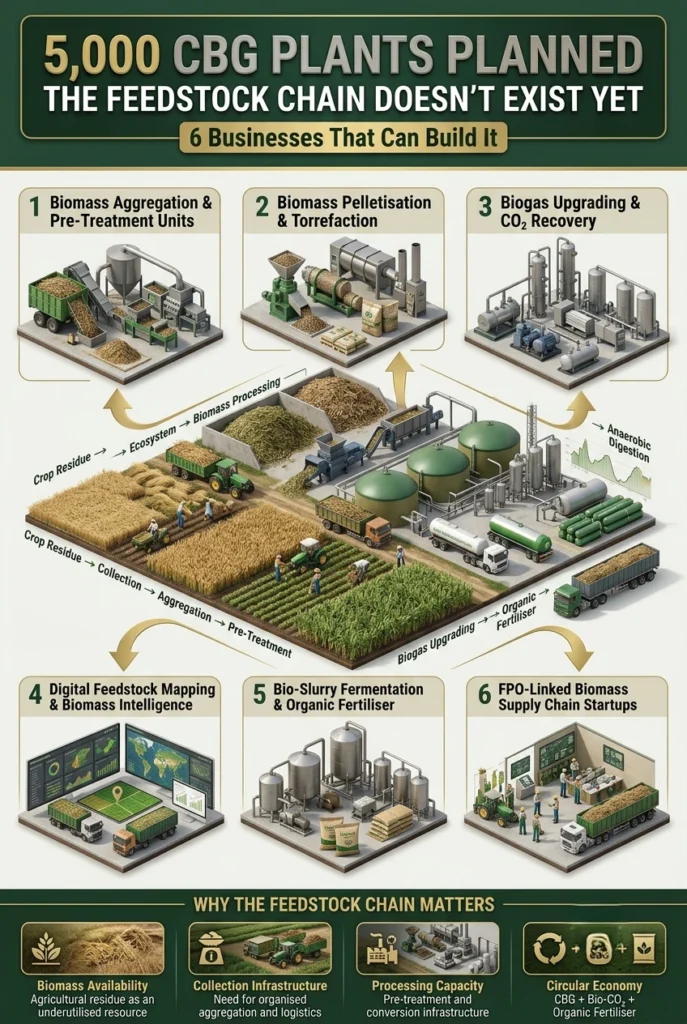
3. Biogas Upgrading Equipment and CO₂ Recovery Units
CBG production yields two important outputs – methane-rich biogas and CO₂. Raw biogas contains 55–65% methane and needs upgrading to CBG grade (95%+ methane). Gas upgrading equipment, such as pressure swing adsorption (PSA) units, water scrubbers, or membrane separators, can achieve this. Most of this equipment is imported today. Manufacturing of biogas upgrading systems or even servicing and maintenance of the plant, by an Indian MSME, will take significant infrastructure spend from every new CBG plant.
The CO₂ recovered from upgrading is another opportunity! Food grade CO₂, industrial CO₂ (refrigerants and welding) and agricultural CO₂ (greenhouse gas) are all expanding fields. A standalone CO₂ recovery and bottling plant setup in a cluster, attached to a dedicated CBG plant or multiple CBG plants can create an additional revenue of ₹ 50 – ₹ 80 lakh per plant per year. The capital investment required for a modular CO₂ recovery unit is between ₹25–₹60 lakh. A niche that is not being served and has high margins!
Get Detailed Insights from This Book: Handbook on Biogas and Its Applications(from Waste & Renewable Resources with Engineering
4. Digital Feedstock Mapping and Biomass Intelligence Platforms
A key question that every CBG developer asks is: From what biomass can I obtain in my catchment area, and for how long? This is an unexpectedly complex question to answer. Biomass is seasonal, it is not uniform and it is in competition for use with other industries. The typical investment recovery period of CBGs is 5 to 7 years, and this means that they need a view on the feedstock supply for that amount of time.
A digital platform that displays availability of Agricultural Residues at village or district level, price trends and seasonal forecasting of availability of these residues is Commercial Gold! Model has proven effective on platforms like Buyofuel. Data science experts can create biomass intelligence services at the district level and offer them to CBG developers, energy companies, and the government. The revenue models range from SaaS subscriptions to data licensing to transaction facilitation fees for biomass trades. Initial investment for the development of the platform is Rs. 20 lakh to Rs. 50 lakh and has near zero marginal cost of scale.
5. Bio-Slurry Fermentation and Organic Fertiliser Manufacturing
All CBG plants generate a significant amount of bio-slurry, which is the liquid and solid material remaining from the anaerobic digestion process. This slurry is high in nitrogen, phosphorus, potassium and micro nutrients and a good organic fertilizer. But, most of the CBG plants in India have not developed the processing line to produce packaged market ready organic fertiliser from raw slurry.
An MSME setting up a bio-slurry processing unit (drying, granulation, bagging and testing of slurry from 1 or more nearby CBG plants) has the potential to earn an additional revenue of ₹30-₹60 lakh per year. The output is eligible for PMKSY and Government of India’s organic farming promotion schemes.
Explore This Book: Complete Guide to Biofertilizers and Organic Farming
6. Farmer Producer Organisation (FPO) Linked Biomass Supply Chain Startups
Farmer Producer Organisations (FPOs) are the most resilient CBG feedstock supply chains in India. FPO-linked aggregation businesses help farmers supply agricultural residues through long-term contracts. Instead of burning residues in the field or selling them on the spot market, farmers can earn a predictable income. This also creates a predictable feedstock supply and bankable contracts for CBG developers.
A start-up that helps enable FPO-CBG developer linkages, to include structuring contracts, quality testing, weighbridge services, and dispute resolution, reaps benefits on both sides of the transaction. Also, renting equipment, such as rakers, trailers, and collection equipment, to FPO members creates a stream of revenue. This model has also been tested with companies in the paddy straw belt of UP. Investment required: ₹10 – ₹50 lakh (depending on the scale), for vehicle fleet and collection equipment. Revenue: the margin on feedstock procurement in addition to equipment rental income.
Import–Export Opportunity Analysis
Export Markets
India’s CBG sector generates two export opportunities. First, biomass pellets are made from agricultural residues. They are in high demand in Europe and Japan. Europe uses them for power station co-firing under EU renewable energy directives. Japan uses them for industrial heat. Indian biomass pellets already sell for $100–$150 per tonne in global markets. Demand is also increasing as Europe moves away from coal.
Import Substitution
CBG-related equipment — including anaerobic digesters, membrane gas upgrading units, high-pressure compressors for CBG compression, and biogas analysers — currently relies largely on imports. India’s CBG sector, with 5,000 plants as the target, represents a captive domestic market worth hundreds of crores annually. Indian MSMEs that develop manufacturing capability for even one or two components of this equipment chain can displace imports and build an export-ready product.
The Engineering Export Promotion Council (EEPC) actively supports MSMEs entering the capital goods export market, with market development assistance and international buyer-seller meets specifically for clean energy equipment.
Indian MSME and Startup Success Stories in the CBG Space
TruAlt Bioenergy / Leafinti Bioenergy — Press Mud to CBG, Gujarat
TruAlt Bioenergy operates a CBG plant in Gujarat processing 200 tonnes of sugarcane press mud daily to produce approximately 10 tonnes of CBG and biofertiliser. Their primary customer base includes city gas distributors AG&P and GAIL. Between January and May 2024, they supplied over 1,000 tonnes of CBG. In a landmark deal, GAIL acquired a 49% stake in a joint venture with TruAlt, committing over ₹600 crore to establish 10 new 10-TPD CBG plants. This demonstrates that a well-structured feedstock-to-plant business can attract blue-chip industrial investors.
Manas Agro Industries — Paddy Straw CBG, Uttar Pradesh
GPS Renewables — Biogas Engineering, Pan-India
GPS Renewables, promoted by Suhas Baxi, has emerged as one of India’s most systematic biogas plant engineering companies. With BPCL partnering with GPS Renewables for CBG plant development, and a pipeline spanning multiple states, the company demonstrates the opportunity for engineering service firms to build durable businesses on the back of India’s CBG expansion. Their success proves that engineering, procurement, and commissioning (EPC) expertise in the biogas space is commercially valuable — even without owning the plants.
Stop guessing—choose the right business with confidence
About Niir Project Consultancy Services (NPCS)
Niir Project Consultancy Services (NPCS) is India’s leading industrial consultancy and project report service, helping entrepreneurs, MSMEs, and investors make confident business decisions across 5,000+ industries. For the CBG and bioenergy sector, NPCS offers:
Detailed Project Reports (DPRs): Bankable, investor-ready project reports covering CBG plant setup, feedstock aggregation units, biomass pelletisation, and bio-slurry processing.
Feasibility Studies: Technical and financial feasibility analysis for CBG-linked manufacturing businesses, including feedstock availability mapping for specific geographies.
Market Research Reports: Demand, supply, pricing, and competition analysis for biomass, CBG, and organic fertiliser markets across Indian states.
Technology Consultancy: Process selection guidance for anaerobic digestion technologies, gas upgrading systems, and biomass pre-treatment methods.
CBG Feedstock Business Opportunity: Quick-Reference Data Table
| Parameter | Details |
| Industry | Compressed Biogas (CBG) / Bioenergy / Biomass Supply Chain |
| Market Driver | Mandatory CBG Blending Obligation (CBO): 1% FY26, rising to 5% by FY29 |
| SATAT Target | 5,000 CBG plants; only ~108 commissioned by mid-2026 — structural gap remains |
| MSME Opportunity | Biomass aggregation hubs, pelletisation units, gas upgrading equipment, digital feedstock platforms, bio-slurry fertiliser manufacturing, FPO-linked supply chains |
| CBG Procurement Price | ₹62–₹72 per kg from OMCs (IOCL, BPCL, HPCL) under 15-year offtake agreements |
| Export Potential | Biomass pellets: $100–$150/tonne to EU/Japan; organic fertilisers: ₹20,000+/tonne to Southeast Asia |
| Government Support | SATAT scheme (MoPNG), MNRE BAM subsidy, GOBARdhan, CGTMSE collateral-free loans, PMEGP, RBI Priority Sector |
| Key Feedstocks | Paddy straw, cotton stalks, maize stover, sugarcane trash, press mud, MSW, chilli/mango/turmeric waste |
| Risk Level | Medium — feedstock seasonality and price volatility manageable through FPO contracts and diversification |
| Growth Outlook | Strong — statutory blending mandate + oil import substitution + carbon credit potential drive long-term demand |
Conclusion: The Feedstock Revolution is the CBG Revolution
As The Hindu’s coverage of the CBG sector rightly identifies, feedstock sourcing is not a supporting factor in India’s compressed biogas story — it is the central story. The plants are being built. The policy framework is in place. The offtake is guaranteed by law. What remains to be built is the biomass supply chain that makes 5,000 plants viable over their 15-year operating lives.
The ₹ multi-thousand-crore opportunity spans biomass aggregation, pre-treatment, digital platforms, by-product commercialisation, and farmer-linked supply chain organisations. It is accessible at investment scales from ₹10 lakh to ₹2 crore. This makes it a genuine opportunity for rural MSMEs, agri-entrepreneurs, technology startups, and larger industrial investors alike.
Act now. The CBG feedstock economy is being built today — and India’s clean energy future depends on who builds it.