Waste Tyre Recycling Business
Waste Tyres as India’s Most Combustible Industrial Opportunity
About 1.2 lakh tonnes of end-of-life tyres are produced in India every year — about 1 lakh tonnes a month. India is set to see a considerable increase in waste tyres over the next decade, with 22.5 million vehicles projected to reach end of life by 2025 and each carrying multiple tyres. Waste tyres are energy dense (calorific value 8,000 kcal/kg, which is higher than the calorific value of coal), contain high levels of recoverable material (rubber, carbon black, steel wire) and are a waste stream targeted by increasing regulatory attention under the EPR rules.
Typical passenger car tyre consists of 47% rubber (natural and synthetic), 22% carbon black, 15% steel cord and wire, 5% textile cord and 11% fillers, accelerators and processing aids. All these elements are commercially valuable when recovered. This article features some of the main avenues of waste tyre products, ranging from the much more familiar crumb rubber applications to the higher investment tyre pyrolysis process.
The Waste Tyre Processing Pathways
The main processing methods for waste tyres include mechanical processing (shredding and granulating to crumb rubber), thermal processing (pyrolysis to get oil, carbon black, and steel), and energy recovery (co-processing as fuel in cement kilns and power plants). The mechanical processing pathway is the most frequent entry point for MSME entrepreneurs, and it only involved a small capital investment, resulting in the production of crumb rubber for a number of well-established applications. Pyrolysis is a high investment pathway (Rs.) There are 2-5 crore (potential revenue) with technical and regulatory complexity.
Explore This Book: The Complete Book on Rubber Processing and Compounding Technology
Top 10 Products from Waste Tyres and End-of-Life Rubber
1. Crumb Rubber Modified Bitumen (CRMB)
Made from waste tires by crushing them to crumb and adding hot bitumen at 3-5% by weight, Crumb Rubber Modified Bitumen (CRMB) is a superior road paving material that has better rut resistance, cracking resistance and 30-40% longer road life than conventional bitumen. The National Highways Authority of India (NHAI) and the Ministry of Road Transport and Highways (MoRTH) have announced that all national expressways and traffic-heavy roads must use CRMB. This policy creates a guaranteed market for crumb rubber producers near highways. The investment required for 5 TPH crumb rubber line is: Rs. 1–2.5 crore.
Access Complete Business Plan: Cardamom Oil Manufacturing Project Report
2. Rubber Flooring Tiles and Gym Mats
3. Tyre Pyrolysis Oil (TPO)
Pyrolysis is a method that decomposes waste tyres at 350–500°C in the absence of air. This process produces several valuable products from each ton of waste tyres, including approximately 400–450 litres of pyrolysis oil, 300–350 kg of black char, 120–150 kg of steel wire, and 80–100 kg of combustible gas. Calorific value of the Tyres Pyrolysis Oil is 9000-10000 kcal/kg. Industries can use this as an alternative fuel for industrial furnace oil applications, marine engines, and industrial boilers. The prices for TPO vary from RS. Each litre is valued at Rs. 25–40 leading to a revenue of Rs. 12,000–18,000 per tonne of waste tyre processed. The cost of investment for the 5 TPD tyre pyrolysis plant: Rs. 1.5–3 crore.
4. Carbon Black from Tyre Pyrolysis
Pyrolytic carbon black (also known as Recovered Carbon Black or rCB) is a char residue from the pyrolysis of tyres. Raw char is sold to the market at Rs. 8,000–15,000 per tonne as a low-grade substitute of carbon black or further processed (milled, pelletised and activated) to get higher value rCB products at Rs. 25,000–60,000 per tonne. rCB is applied in rubber compounding, printing inks and pigments. ASTM standard rCB (ASTM D8178) is offering quality measurements and a growing acceptance in industry.(Waste Tyre Recycling Business)
Related Article: How to Start a Tyre Carbon Black Powder Manufacturing Business in India (Complete Guide for MSME Entrepreneurs)
5. Steel Wire Recovery
Tyre pyrolysis or mechanical tyre shredding steel wire is a clean and high-carbon steel wire fit for resale to steel scrap dealers or wire rod manufacturers. At Rs. Businesses can add steel wire recovery to pyrolysis and mechanical processing to generate a substantial revenue source of ₹30,000–40,000 per tonne. Mechanical processing without pyrolysis efficiently recovers steel through magnetic separation after granulation.
Get Detailed Project Report (DPR): Steel Wire Rope
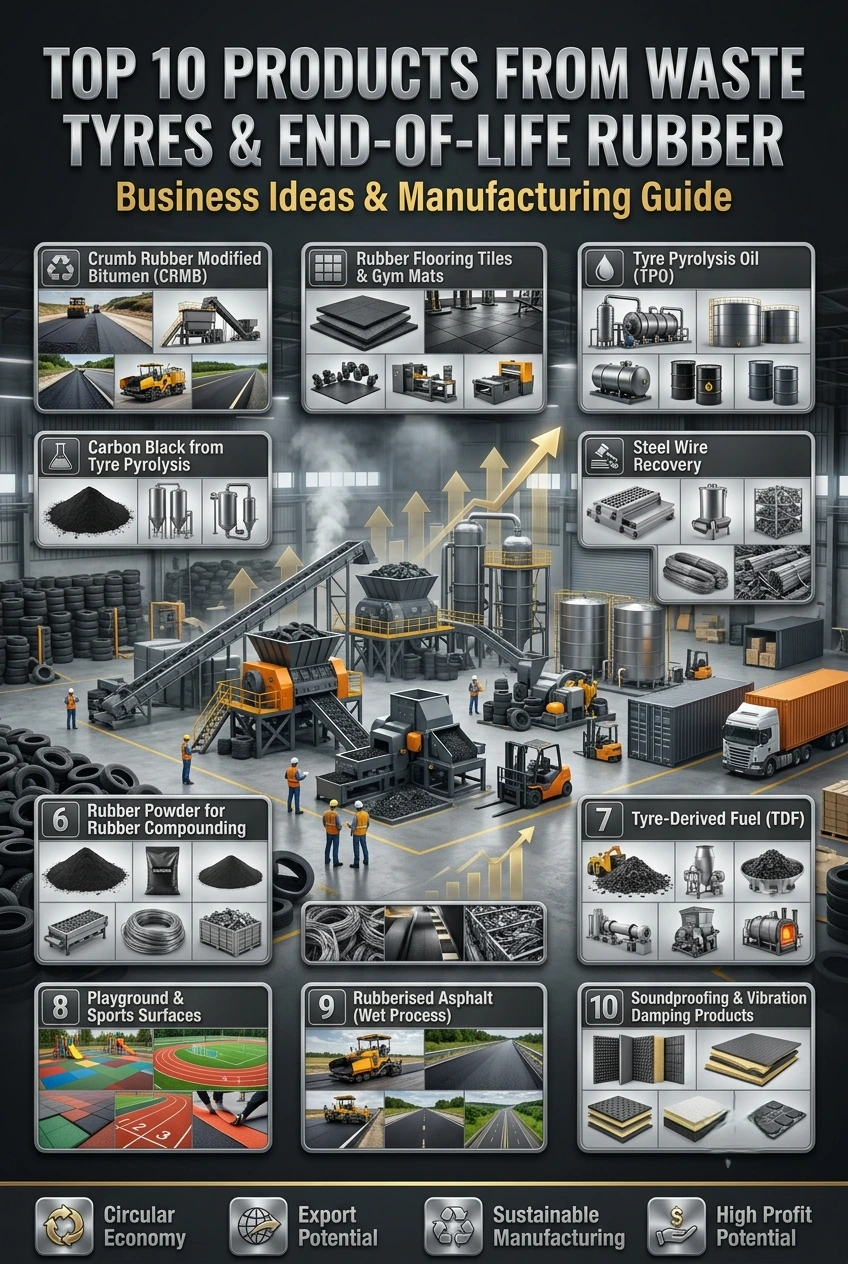
6. Rubber Powder for Rubber Compounding
Devulcanised rubber compound for the production of new rubber articles such as hoses, seals, gaskets, soles for footwear and sports equipment is ultra-fine crumb rubber powder (< 80 mesh). Devulcanisation (removing sulphur cross-links to restore rubber plasticity) uses further chemical or microwave treatment, which allows manufacturers to use crumb rubber at 10–30% levels with virgin rubber in compounds. The cost of a crumb rubber fine grinding & devulcanisation unit is Rs. 1.5–4 crore.(Waste Tyre Recycling Business)
Get Detailed Project Report (DPR): Rubber & Rubber Products Manufacturing Guide
7. Tyre-Derived Fuel (TDF) for Cement Kilns
The whole tyres or tyre derived fuel (TDF) chips are used as coal substitutes in the pre-calciner part of the cement kiln. One tonne of TDF replaces around 0.6–0.7 tonnes of coal during burning, and cement manufacturers use the ash in clinker without leaving any residue. Cement companies with waste management authorisation must take hazardous and non-hazardous waste for co-processing. TDF suppliers can construct Rs. Businesses involved in collection, chipping and selling tyres to nearby cement companies with an annual turnover of 20–50 lakh.(Waste Tyre Recycling Business)
8. Playground and Sports Surfaces
Rubber granules from waste tyres serve as the main infill material for synthetic turf sports fields (football, hockey, cricket) and poured-in-place playground safety surfaces. The amount of rubber granules needed on each synthetic football pitch is 50-80 tonnes. Rising investments in the sports infrastructure in India, including stadiums, school playgrounds, sports academies, etc., generates good domestic demand. There is also an opportunity to export to the sports facility developers in Southeast Asian and Middle Eastern countries.
9. Rubberised Asphalt (Wet Process)
The wet process dissolves crumb rubber in hot asphalt cement instead of dry-blending it with aggregates. This process creates rubberised asphalt, which delivers higher performance than CRMB for road paving. Rubberised asphalt is 50% more resistant to fatigue and reduces tyre noise in comparison to conventional asphalt. There are a few state PWDs who are undertaking to test rubberised asphalt specifications for high traffic urban roads.
10. Soundproofing and Vibration Damping Products
Rubber granule-based soundproofing underlay for flooring, vibration damping pads for industrial machinery, and railway track anti-vibration mounts are growing applications for crumb rubber. Railway Vibration Damping Systems used under metro rail and high-speed train tracks represent a technically demanding but high-margin application. Investment depends heavily on the specific product, ranging from Rs. 50–200 lakh.(Waste Tyre Recycling Business)
Investment and Revenue Summary
| Product | Investment (Rs.) | Price per Tonne Input | Revenue per Tonne Tyre |
| CRMB (Crumb Rubber) | 1–2.5 crore | Rs. 30,000–60,000/MT crumb | Rs. 15,000–25,000 |
| Rubber Tiles / Mats | 50–120 lakh | Rs. 80,000–1,20,000/MT tile | Rs. 20,000–35,000 |
| Tyre Pyrolysis Oil | 1.5–3 crore | Rs. 25,000–40,000/1,000L | Rs. 15,000–22,000 |
| Carbon Black (rCB) | 1.5–3 crore (with pyrolysis) | Rs. 8,000–60,000/MT | Rs. 4,000–18,000 |
| Steel Wire | Included in shredder | Rs. 30,000–40,000/MT | Rs. 4,500–6,000 |
| TDF for Cement | 20–50 lakh | Rs. 3,000–6,000/MT TDF | Rs. 2,500–5,000 |
How NPCS Helps Entrepreneurs Enter This Sector
Here at NPCS (Niir Project Consultancy Services) we offer professional consultancy for Market Survey cum Detailed techno-economic feasibility Reports (DPR) for establishing waste tyre and rubber recycling manufacturing industries. These include all about the manufacturing process, market demand of manufactured products, Process Flow Diagram, plant layout, machinery and raw materials. Total project financial analyses have been provided with profitability analysis.
If you are an entrepreneur intending to enter waste-based manufacturing, NPCS project reports are your guide to have a technical and economic backing to knock the doors of bankers, investors and government bodies with confidence. Visit www.niir.org to explore our full library of waste-based project reports.
Build a profitable business with the right idea
Conclusion: The Business Case for Waste Tyre Manufacturing
India’s waste tyre crisis — 1 lakh tonnes generated monthly and growing — is simultaneously one of its largest environmental problems and most accessible manufacturing opportunities.
Industries already produce crumb rubber, pyrolysis oil, and rubber flooring as proven products. These products have established markets, receive growing policy support, and use raw materials available below Rs. 5,000 per tonne. The NHAI mandates on CRMB provide guaranteed institutional demand for crumb rubber — an unusual combination of market certainty and low-cost input for MSME manufacturers.
Entrepreneurs who move early into waste-based manufacturing secure raw material relationships, buyer networks, and regulatory approvals that latecomers find difficult to replicate. The best time to act on these business ideas is before the sector becomes crowded — and for most waste streams profiled here, that window is still open.(Waste Tyre Recycling Business)
Key References and Useful Links
- Ministry of MSME — Government of India
- Make in India — Official Portal
- DPIIT — Department for Promotion of Industry
- APEDA — Agricultural Export Development
- NPCS — Waste-Based Project Reports
- Ministry of Environment, Forest and Climate Change
Frequently Asked Questions (FAQ)
Q1. What licences are required to operate a tyre pyrolysis plant in India?
A Tyre pyrolysis plant needs consent to establish and consent to operate from the state PCB and for larger plants need Environmental Clearance, rules are applicable on handling hazardous waste. The Central Pollution Control board (CPCB) had issued guidelines for operation of tyre pyrolysis plants.
Q2. How is waste tyre supply secured for a manufacturing unit?
Scrap automobile yards, tyre recasters, tyre dealers, owners of big motor pools/fleets, and municipal solid waste collectors collect bulk tyre scrap. Largest fleets are reliable to be biggest scrap tire supplying organizations (eg. Govt Transport Co etc). A formal tyre collection agreement with 3–5 sources ensure supply security.
Q3. What is the quality specification for crumb rubber used in CRMB?
MoRTH specifications for CRMB require crumb rubber of 30–40 mesh size (0.4–0.6 mm), with a maximum of 0.5% steel and fibre contamination, minimum 95% rubber content, and specific surface area and Mooney viscosity parameters. BIS IS 15462 specifies CRMB performance requirements.
Q4. Can pyrolysis oil be sold as diesel substitute?
Selling Raw Tyres Pyrolysis oil as petroleum fuel product is not directly possible as per standards. It is considered as a fuel product not suitable for directly selling as standard petrol product & need to be considered as Fuel Oil for Industry Furnaces or through Refining for BIS & PESO certification for blending in petroleum products which makes the task cumbersome whereas it can be readily used in Industry as fuel for Boilers with less compliances.
Q5. What is the EPR framework for end-of-life tyres?
Under the EPR rules of the Environment Ministry, tyremakers, dealers and importers will be responsible for the collection and recycling of end-of-life tyres. Registered tyrecylers either as PRO or EPR-registered processors will be able to earn EPR credit from those companies seeking credits to meet collection targets.
Q6. What are the best locations for waste tyre recycling businesses?
Reliable supplier is either in vicinity of municipal car junkyards and national highway based heavy vehicle junk-yards and fleet operation company’s fleet operation centres and large fleet owners, as also around tyre retreading belts (Mumbai, Chennai, Delhi, Pune & Hyderabad). Proximity to highway construction projects is ideal for CRMB-focused operations.