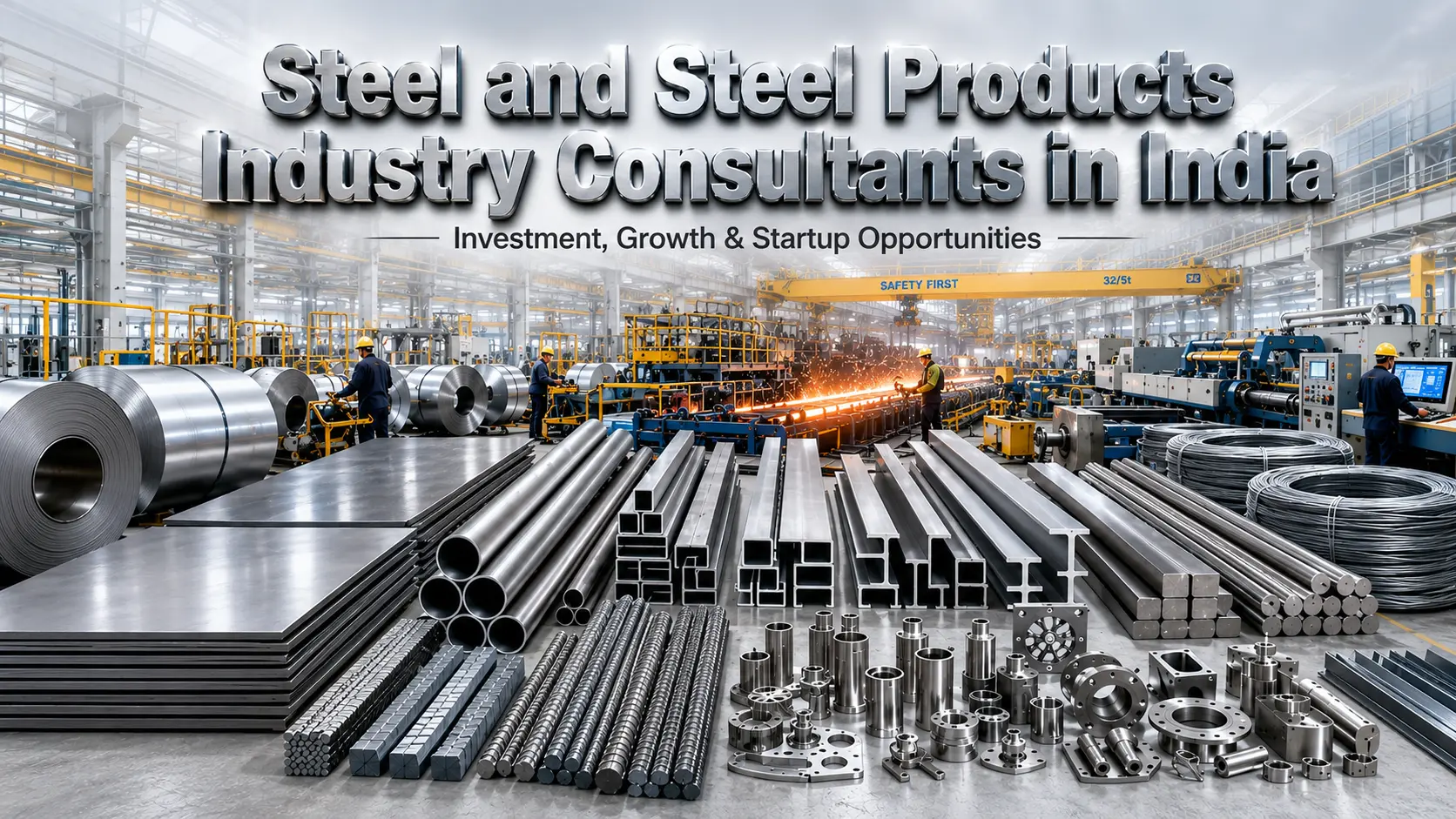

Steel and Steel Products Industry
Why the Right Consultancy Partner Can Define Your Steel Project’s Future
The steel industry is at a pivotal moment in India. Now the country has become the second largest producer of crude steel in the world with its total production capacity crossing 220 MNTRY and target of the government is 300 MNTRY by 2030. This is great news for an entrepreneur, MSME investors and NRI project planners but also poses a great technical challenge. It is the steel and steel products industry consultants in India who add irreplaceable value to navigating that complexity. The entire spectrum of this business, from the rolling mill, cold rolling units, stainless steel fabrications to the alloy steel foundries, requires careful engineering, regulatory expertise, and sound financial feasibility studies. Even a well-financed steel business can make expensive mistakes in the plant layout, process selection, or compliance if not properly guided.
It’s all about the steel and steel products as they come in a surprising variety of product types – hot-rolled coils, cold-rolled sheets, tinplate, carbon steel billets and alloy steel castings, forged parts, mild steel bars, stainless steel products, pelletizing units – just to name a few. There are technical specifications, machinery requirements, raw material chains and regulations for each sub-category. Great steel and steel products consultants in India have in-depth knowledge of these nuances. They come with domain-specific expertise that generalist consultants can’t match. In this article, we delve into the work of these consultants, how to identify and narrow down the options for the most suitable steel industry consultants in India, and the crucial impact that reputable Indian steel consultancies can have in converting project concepts into viable, investor-friendly ideas.
What Steel Plant and Process Consultants Actually Do
Many first-generation entrepreneurs think that the job of a steel plant consultant is to prepare a business plan or a project report. However, The scope is in fact very wide and much more technical.
A qualified steel and steel products process consultant usually starts the process by conducting a technology assessment, to determine whether the entrepreneur’s product idea is best suited to an induction furnace route, an electric arc furnace configuration, a rolling mill configuration, or a finishing line for the specialist. This technology choice has direct implications on the capital expenditure, energy costs, and end product quality. Moreover, It’s possible to ruin project economics from the get-go if it’s done incorrectly.
The next phase after technology selection is to prepare a feasibility study. This includes raw material sourcing and cost analysis, manufacture process description, plant capacity planning (tonnes per day/Million tonnes per annum), utility requirement, and a comprehensive project financial model with capital cost, working capital cost, revenue projection and profitability analysis. There will generally be a detailed project report (DPR) after this, which is the document that banks, private equity investors and government lending agencies such as SIDBI and NABARD will use to assess the project for its financing.
Get Detailed Insights from This Book: Explore the Complete Steel Technology Book
In addition to feasibility and DPR, steel process consultants frequently assist in plant layout and engineering design, machinery procurement specification, EPC (Engineering, Procurement and Construction) vendor shortlisting and commissioning guidance. A few boutique management consulting firms in India also provide regulatory compliance assistance, which entails assisting with steel entrepreneurs in meeting the requirements for product certification from Bureau of Indian Standards (BIS), environmental clearances from the Pollution Control Board, and registrations with Factory Act. All of this end-to-end support makes the difference between a process plant consultant that is really capable, and one that just sends a standard report out.
Why India Has Become a Hub for Steel and Steel Products Consulting
India has become one of the busiest markets for steel project consulting in Asia thanks to a number of converging factors. The government’s Production Linked Incentive (PLI) scheme for specialty steel has attracted around USD 1.2 billion of guaranteed investments in the industry, focusing on high-value specialty steel products like coated steel, high strength steel, specialty alloys, and stainless-steel grades. This PLI momentum has directly resulted in a rise in the demand for expert consultancy support, since PLI applications, in themselves, require technically sound feasibility studies and process documentation of the product.
At the same time, India’s infrastructure initiatives for roads, rail, ports, affordable housing, and urban metros continue to provide a robust demand for steel in the domestic market. India’s finished steel market is expanding at about 7–9% per year and is one of the fastest growing markets in the world. The demand curve has given impetus to a new breed of brownfield expansions and greenfield steel projects in states such as Odisha, Jharkhand, Chhattisgarh, Gujarat and Maharashtra. These projects need to be supported by detailed engineering consultancy.(Steel and Steel Products Industry)
Get Detailed Project Report (DPR): Steel and Steel Products Project Book
Another strong impetus is importing substitution. The BIS has increasingly become stringent with quality control orders (QCOs) issued by the Ministry of Steel and the certification is now mandatory for a larger number of steel products. This has led to domestic manufacturing opportunities in segments traditionally dominated by imports, specifically specialty flat products, high-grade stainless steel and value-added alloy steel components. Process engineering consultants familiar with the technical specifications and quality norms in these import substitution areas are required for the entrepreneurs entering these import substitution areas. Further, India’s export of steel has also seen a significant improvement, as finished steel exports have surpassed 6 million tonnes in the last fiscal year, indicating the Indian steel industry is now competing in the international market, thus requiring consultants to assist them in achieving international quality standards.
How to Evaluate and Shortlist the Best Steel Industry Consultants in India
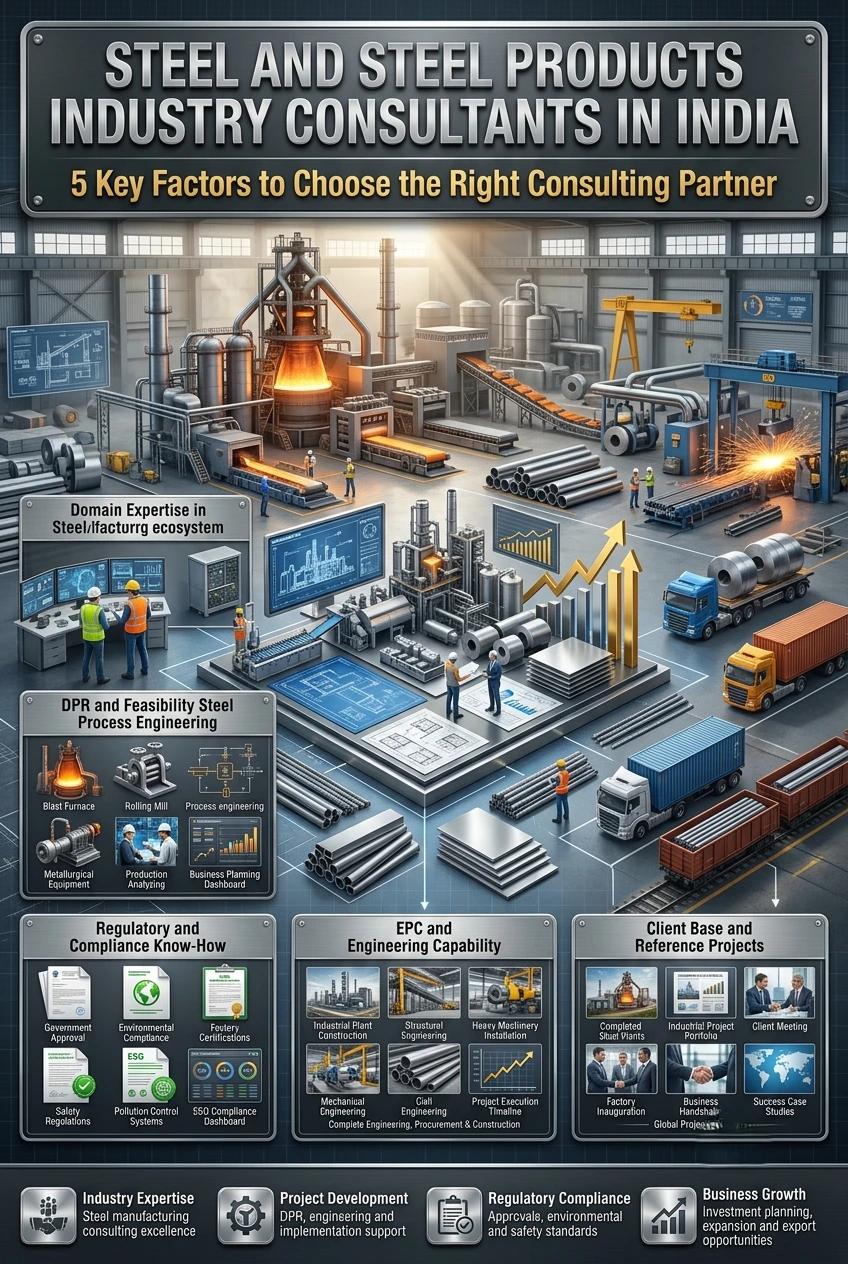
1. Domain Expertise in Steel Process Engineering
First of all, the top steel and steel products industry consultants in India must have deep technical expertise in steel process engineering. Ask directly: has the firm done feasibility studies or DPRs for rolling mills, foundries, cold-rolling units or stainless-steel plants? Do they have an understanding of electric arc furnace (EAF) and induction furnace (IF) technology and downstream finishing and surface treatment? Process engineering consultants who have specialized experience in the ferrous metallurgy value chain – iron making, steel making, rolling and fabrication – can provide insight that is not available from consultants with a cross-sector or general engineering background. The domain depth is important for the steel and steel products sub-sectors (e.g. alloy steel forgings, carbon steel tube manufacturing, tin plate production) in which the process parameters are very specific.
2. DPR and Feasibility Track Record
When considering any company, check their history with regards to creating detailed project reports for steel and allied manufacturing projects. A credible consultant can present the project techno-economic reports, machine layouts, process flow/diagrams, and project financials. Also, see if their DPRs are accepted by banks and financial institutions for the project financing. Even if a DPR looks great, it can’t fulfil its purpose if it does not meet lender criteria. The top steel industry consultants in Delhi and all-around India always provide bankable project reports that meet the documentation requirements of SIDBI, commercial banks and government schemes like Credit Linked Capital Subsidy Scheme (CLCSS).
3. Regulatory and Compliance Know-How
Indian steel industry is operating in multi-layered regulatory framework. The Ministry of Steel, Government of India (steel.gov.in) is the main monitoring agency that sets production, pricing and quality policies for the steel industry. Now, more and more steel products are mandatorily required BIS certification under the Quality Control Orders issued by the Ministry of Steel in India. The environmental compliance regime, maintained by the State Pollution Control Boards, is essential for any steel melting/rolling/surface treatment unit, and requires consent-to-establish and consent-to-operate approvals. The Factory Act is relevant to workplace safety and licensing of factories with over threshold staffing. Further, government incentive schemes would require a GST registration and MSME Udyam registration for project eligibility. A qualified steel and steel products plant consultant should be able to advise in advance on all these requirements and not just in an ad hoc manner.
Turn your budget into a successful business plan
4. EPC and Engineering Capability
In the case of bigger steel projects like rolling mills, integrated steelmaking facilities or pellet plants, you require a consultant who can either execute or valueably coordinate EPC (Engineering, Procurement and Construction) activities. EPC consultants for steel projects manage detailed engineering drawings, equipment specifications, vendor qualification, managing machinery supply chain for the plant and commissioning oversight. Make sure the firm has either the capability or has partnerships with civil, structural and mechanical engineering companies. Process plant consultants that just provide reports are not sufficient for mid to large scale steel projects because they don’t have engineering implementation experience.
5. Client Base and Reference Projects
Last but not least, review the firm’s clientele — looking at industry (steel, ferrous metals, allied manufacturing) and project size (MSME units, medium-sized plants, integrated large-scale projects). A consultant who has a well-rounded reference list from various steel sub-sectors is adaptable and knows their stuff. With regard to the best steel industry consultants in Delhi, ask the firm if they have served clients in other leading steel-producing zones like Odisha, Chhattisgarh, and the new hotspots in Gujarat and Telangana. Geography is important because the availability of raw materials, logistics costs, and incentives given by the States are different and a consultant with exposure to projects in multiple States will do you better.(Steel and Steel Products Industry)
Role of NPCS in Steel and Steel Products Project Consultancy
One of the well-established and recognized steel and steel products project consultancy firms in India is Niir Project Consultancy Services (NPCS), from New Delhi at niir.org, which has a proven history in steel and steel products project consulting for more than 30 years. NPCS has been working since 1994 to prepare detailed project reports and techno-economic feasibility studies in various steel sub-sectors such as rolling mills, cold rolling units, foundries, hot rolling plants, stainless steel fabrication units, tinplate manufacturing, alloy steel projects, pelletizing plants, carbon steel production, mild steel processing, etc.
The company’s worth to steel entrepreneurs is the thoroughness of its project documentation. Typical NPCS steel project report includes manufacturing process description (step-by-step), list of machines and equipment with specification, raw material procurement and analysis, plant layout, process flow diagram, market study and demand-supply analysis of the particular product, product mix and capacity estimation in MT/TPD, financial model (capital expenditure estimation, working capital assessment, revenue projection, break-even analysis, profitability ratio), etc. The level of detail found in this report is precisely the type that banks, investors and government agencies are seeking when considering a steel project for funding.
In 30 years, NPCS has provided its clients with more than 150,000 successful project consultancy engagements across 85 countries. The firm has a vast steel and steel products project profiles catalog which enables the investors and entrepreneurs to browse steel and ferrous metals projects for various ideas in the value chain before taking any decision to move with any particular idea.
Related Article: Steel Manufacturing Plant Setup in India: Investment, Machinery & PLI Incentives
In the wider India consultancy market, NPCS is a sub-segment of boutique management consultancies in India with a depth of industrial research combined with hands-on experience in project implementation. Furthermore, While most large strategy consulting firms specialize in engagements focused on corporate transformation, NPCS is dedicated to providing entrepreneurs with the technical and process engineering documentation and guidance required to help them form a viable company, while also providing them with market intelligence based on real manufacturing economics. Moreover, This hands-on approach is sometimes the deciding factor for project viability or its deadlock at the conceptual phase, especially for first-generation steel entrepreneurs.
Best Steel Industry Consultants in Delhi and the India Consultancy Landscape
Delhi – and the National Capital Region – is indeed the nerve centre of India’s industrial consultancy market. Delhi is a home for Steel project consultancy because of its close proximity to the Ministry of Steel, BIS headquarter, various government financing bodies including the SIDBI and various banking decision making centres. The best steel industry consultant Delhi normally has established connections within these institutions, which is highly beneficial when a client’s project necessitates regulatory approvals, BIS certification guidance or financing support.
Outside of Delhi, consultants based in Mumbai tend to be more suited to the western corridor clients investing in Gujarat’s swelling steel manufacturing belt, while companies in Kolkata or Bhubaneswar are more likely to be able to offer services to the steel belt of Odisha and Jharkhand, where large integrated steel plants are located. Furthermore, Process engineering consultants from Hyderabad and Pune supply a growing market in the south and west, where downstream steel product manufacturing (such as auto components, fabricated structures and precision castings) is expanding in tandem with the growth of the automotive sector.
Consulting Service Types: What They Cover and Who Needs Them
The table below outlines the main consulting service categories relevant to steel and steel products projects in India:
| Consulting Service Type | Core Focus | Key Deliverables | Best Fit For |
| Techno-Economic Feasibility Study | Market demand, production economics, investment sizing | Feasibility report, financial model, capacity recommendation | First-time steel entrepreneurs; pre-investment stage |
| Detailed Project Report (DPR) | Bankable project documentation for financing | Process description, plant layout, financial projections, machinery list | Entrepreneurs seeking bank loans or government scheme benefits |
| Process Engineering Consultancy | Manufacturing process selection and optimization | Process flow diagrams, equipment specs, utility requirements | Brownfield expansions; technology upgrade projects |
| EPC Consultancy | End-to-end project execution | Engineering drawings, procurement support, commissioning plan | Large rolling mills, integrated steel units, greenfield plants |
| Regulatory and Compliance Advisory | BIS certification, PCB clearances, Factory Act compliance | Compliance roadmap, documentation support, license assistance | All steel projects requiring statutory approvals |
| Market Research and Business Plan | Demand-supply analysis, competitor mapping, pricing trends | Market intelligence report, sales projection, business plan | Investors and NRIs evaluating steel sector entry |
Frequently Asked Questions
1. How much does a detailed project report for a steel plant cost in India?
DPR costs vary based on project scale and scope. What do you have to Pay for a DPR: The fee for a small induction furnace or MSME level rolling mill unit can range from fifty thousand rupees to even two lakhs depending upon the consultant and the coverage. High cost of an integrated steel project or an EPC level Engineering DPR can come in the millions of rupees and the quotations will be given individually. Always check on what this DPR offers – like for example is it covering the market research, process Engineering and lay outs and is it specifically for submission to bank.
2. What is the difference between a process consultant and an EPC consultant for steel projects?
A process consultant focuses on the technical and economic planning stages — manufacturing process selection, feasibility study preparation, DPR writing, and compliance guidance. An EPC consultant, on the other hand, takes the project from detailed engineering design through procurement of equipment and construction to commissioning. For smaller steel projects, a process consultant’s DPR is sufficient for financing and licensing purposes. For large rolling mills or integrated steel units above a certain capacity, EPC consultancy becomes necessary to manage the full project execution cycle.
3. How do I choose the best steel plant consultant in India for a new rolling mill project?
Start by shortlisting firms with demonstrated experience in rolling mill feasibility studies and DPRs — ask for specific project references. Verify that the firm understands BIS quality standards applicable to your product (e.g., IS standards for TMT bars, structural sections, or flat products). Check that the DPR they produce meets bank-financing requirements. Also assess whether the firm has knowledge of the Ministry of Steel’s PLI scheme eligibility criteria if your project involves specialty steel products, as PLI benefits can significantly improve project economics.
4. Is BIS certification mandatory for steel products manufactured in India?
Yes. The Ministry of Steel has issued Quality Control Orders (QCOs) mandating BIS certification for a growing list of steel products sold in the domestic market. These QCOs cover products ranging from TMT bars and structural steel to flat products, pipes, and several alloy steel grades. For entrepreneurs planning a steel manufacturing unit, securing BIS certification is a pre-commercial requirement. Your steel and steel products industry consultant should identify the applicable BIS standards for your product category at the project planning stage and include a compliance roadmap in the project documentation.
5. Can I access multiple steel project ideas and business plans in one place before deciding on a specific product?
Yes. NPCS — Niir Project Consultancy Services (niir.org) — maintains an extensive catalog of project profiles and feasibility study reports for steel and steel products, covering sub-sectors such as alloy steel, cold rolling, hot rolling, stainless steel, pelletizing, carbon steel, tinplate, foundry products, and forge products. Entrepreneurs can browse the steel project profiles page to evaluate multiple business opportunities before commissioning a full custom DPR for their chosen project.
6. What government incentives are available for new steel manufacturing units in India?
Several central and state government schemes support steel entrepreneurs. Additionally, The PLI scheme for specialty steel offers financial incentives linked to incremental production for eligible product categories. The Credit Linked Capital Subsidy Scheme (CLCSS) under the MSME Ministry supports technology upgradation in manufacturing units including small steel plants. Many steel-producing states offer state-level capital subsidies, power tariff concessions, and stamp duty exemptions for new industrial units. Your project consultant should provide a comprehensive incentive mapping as part of the feasibility study to optimize the project’s financial structure.
Conclusion: Your Next Steps Toward a Viable Steel Project in India
India’s steel and steel products sector offers some of the most compelling manufacturing investment opportunities in Asia today. Moreover, Rising domestic demand, strong government policy support, import substitution opportunity, and growing export potential together create a favorable landscape for entrepreneurs and investors willing to invest in well-planned steel projects. However, the sector’s technical complexity, multi-layered regulatory requirements, and capital intensity make professional consultancy support essential — not optional.
Start by clearly defining your product focus — whether that is long products, flat products, stainless steel, alloy steel castings, or downstream fabricated components. Then engage a qualified steel and steel products process plant consultant who can prepare a technically sound feasibility study and a bankable DPR. Additionally, Prioritize consultants with demonstrated domain expertise in ferrous metallurgy, a track record of BIS-compliant process documentation, and knowledge of the Ministry of Steel’s current quality control and incentive framework.(Steel and Steel Products Industry)
For entrepreneurs in the early project identification stage, explore NPCS’s steel and steel products project profiles catalog at niir.org to survey viable business opportunities across the ferrous metals value chain. Additionally, For those ready to commission a custom project report, engage directly with a consultant firm that can customize the feasibility study to your specific location, capacity, and product mix. Therefore, The right consultancy partnership at the start of your steel project journey is among the best investments you can make in the project’s long-term success.(Steel and Steel Products Industry)
Key References for India’s Steel and Steel Products Sector
Entrepreneurs and investors researching steel project opportunities in India can refer to these credible sources:
- Ministry of Steel, Government of India: steel.gov.in
- Indian Steel Association (ISA): indsteel.org
- Institute for Steel Development and Growth (INSDAG): steel-insdag.org
- India Brand Equity Foundation — Steel Industry Report: ibef.org/industry/steel-presentation