
Introduction: Vermicompost Manufacturing Business in India
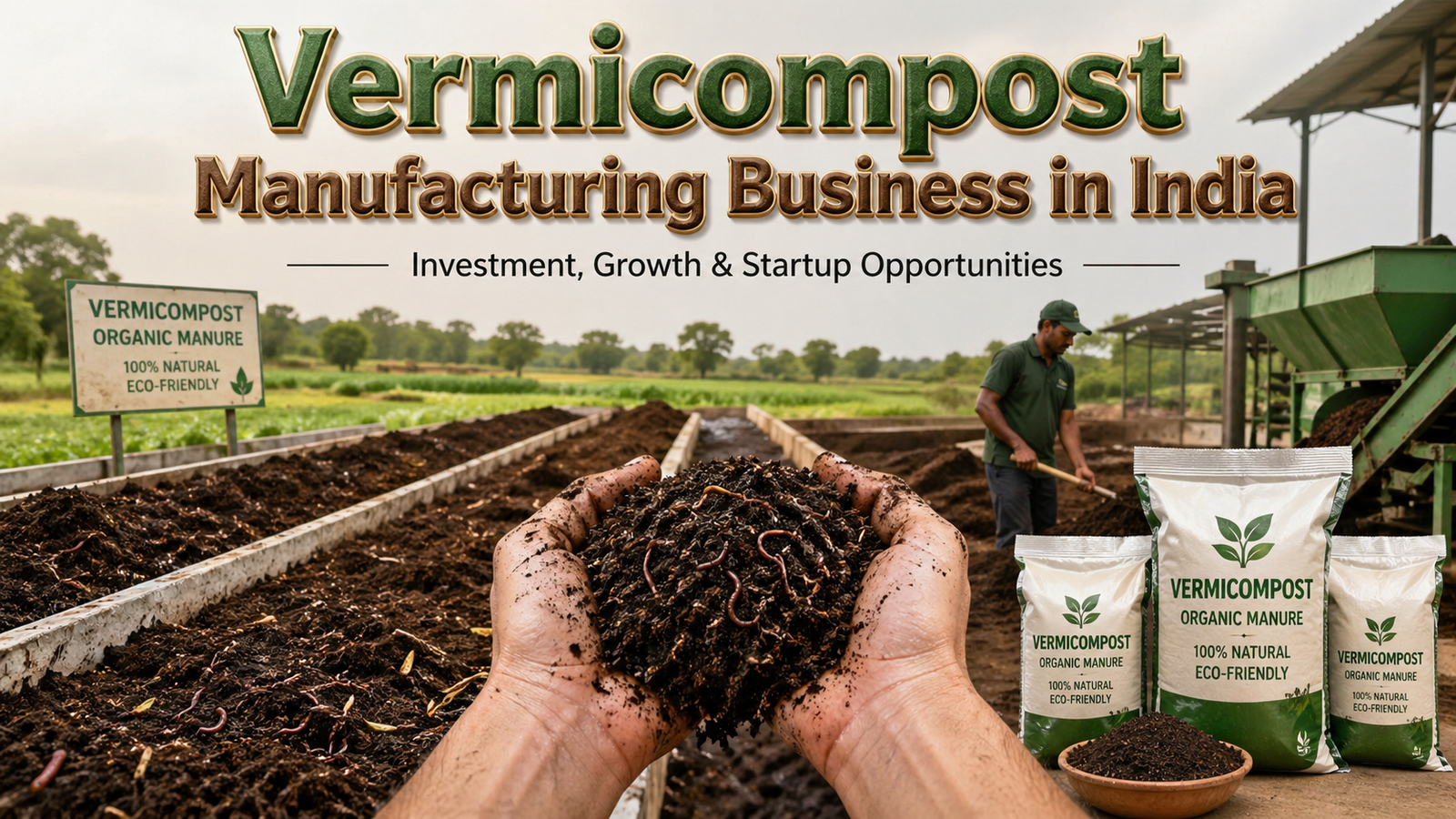
Vermicompost manufacturing business in India is one of the most promising and profitable MSME ventures in agriculture. As entrepreneurs are still sticking to traditional manufacturing or trading, the market for organic manure is widening due to challenges of soil health, irrigation water quality, high cost of fertilizers, and support from the government for natural farming.
Agriculture in India is transitioning to sustainability. PKVY (Parampara at Krishi Vikas Yojana) schemes and state-led Organic Farming Missions have stimulated production and use of organic farming inputs and reduction in use of chemical fertilizers so as to promote organic fertilizer such as vermicompost use. This is a long-term shift in the country’s agriculture.
Get Detailed Insights from This Book: Complete Guide to Vermiculture and Vermicomposting
Why Demand for Vermicompost is Increasing
There is a simultaneous increase in demand for organic manure from different sectors. Soil degradation from chemical fertilizers is a serious problem for farmers. Meanwhile, consumers are looking for chemical-free food, which is encouraging farmers to adopt organic farming.
Organic farming clusters set up by the government are a major driver. Governments in states such as Maharashtra, Uttar Pradesh, Madhya Pradesh, Karnataka and Rajasthan are encouraging organic farming, in which Vermicompost plays a central role.
Organic inputs are also being used by commercial farming. Greenhouse farmers, export vegetable growers and contract farming companies are also using organic manure.
City demand is also rising sharply thanks to home gardening and the sale of gardening inputs online.
Why This Business is Promising
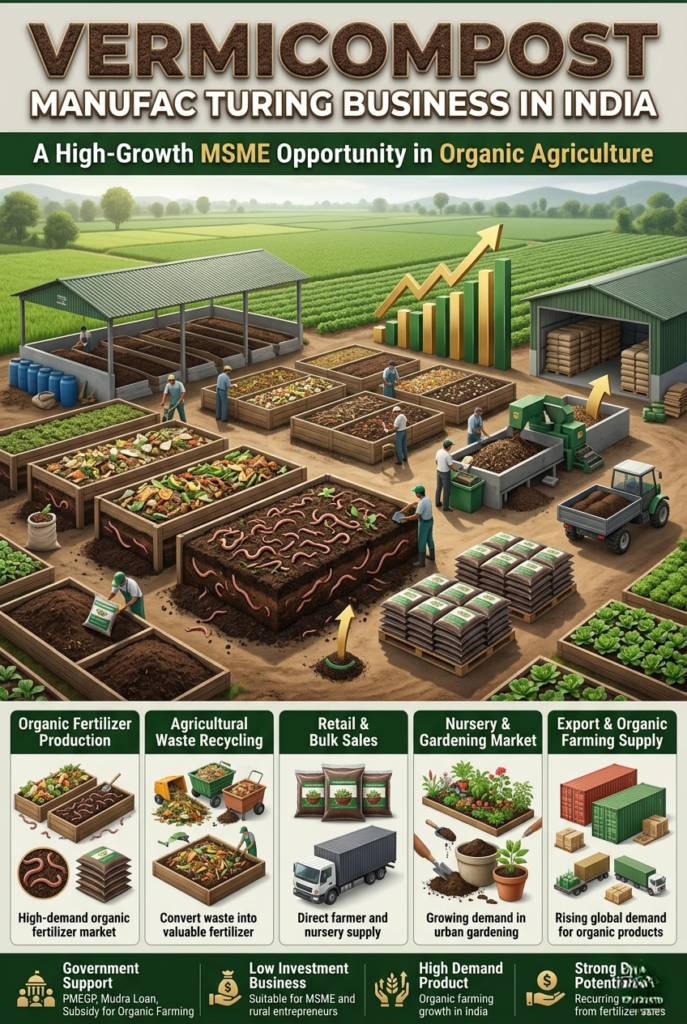
The vermicompost business is appealing due to its simplicity and low capital outlay. Cow dung, crop residues, and organic waste are cheap raw materials which are abundantly available in rural India.(Vermicompost Manufacturing Business in India)
The waste conversion is biological and does not involve sophisticated machinery and processes. The waste is converted into compost by the action of earthworms in 45 to 90 days.
Key benefits of this business are:
- Low investment requirement
- Simple production technology
- Demand in agriculture sector
- Subsidies from government
- Easy to set up small or large scale
This makes it the best choice as a first venture.
Related Article: How to Start a Profitable Vermicompost Business
Investment and Profitability
The capital outlay varies, depending on scale. A rural unit can be set up with an initial investment of ₹8 lakh to 15 lakhs (can produce 10-30 tons per month). A medium-sized branded unit can cost ₹18 lakh to ₹30 lakh and larger commercial units can cost up to ₹60 lakh.
Margins are dependent on the type of business. Wholesale sales have a lower margin, while branded retail has a higher margin.
- Bulk sales margin: 20% – 28%
- Branded retail margin: 35% – 45%
- Export price: Higher than bulk sales price
This is why entrepreneurs eventually switch from bulk to brand.
Manufacturing Process of Vermicompost
The process of production is simple but needs to be managed. Organic waste is gathered and pre-composted. Then, it is spread in shady beds and earthworms are added.
Water and temperature need to be controlled. The compost is ready for harvesting after 45-90 days, and then sieved and bagged for the market.
The process can be broken down into:
- Collection of organic waste
- Pre-decomposition
- Bed preparation
- Earthworm introduction
- Controlled composting
- Harvesting and packaging
Careful cultivation results in good quality product and cycle times.
Get Detailed Project Report (DPR): Detailed Vermicompost Business Plan and Feasibility Study
Market Opportunities in India
Vermicompost markets are growing on several fronts. Official procurement markets are the most secure, particularly under organic farming programs.
Private agricultural markets are also significant, such as FPOs, agricultural dealers and contract farming firms. City markets are also increasing because of urban gardening and organic living.
Exports are also growing in markets like Nepal, Bangladesh, UAE and Sri Lanka.
Licensing and Legal Requirements
For legal operation, certain registrations are:
- MSME (Udyam Registration)
- GST Registration
- Fertilizer Control Order (FCO) License
Organic businesses need APEDA registration for exports.
Cow dung, crop residues, and organic waste are cheap raw materials which are abundantly available in rural India.
Role of NPCS in Business Setup
Niir Project Consultancy Services (NPCS) plays an important role in helping entrepreneurs set up vermicompost plant. The company offers project reports, feasibility reports and financial plans.
NPCS helps in:
- Bankable project reports
- Projecting real investments and profits
- Choosing machines and capacity
- Knowing break-even and return on investment
- Assisting with loan and subsidies
This will help new entrepreneurs minimize their risks and make better decisions.
Choose the right startup backed by real market demand
Future of Vermicompost Industry in India
The industry’s future is tied to the shift to organic farming in India. There is steady government policy support for lower chemical fertilizer use and higher organic input use.
Farmers and consumers are increasingly becoming aware of its benefits, which will sustain demand. Organic manure production will soon emerge as a promising agro-based MSME industry in India within the next decade.
Conclusion
Vermicompost production business has a high growth potential with low investment and is a good choice for an MSME in India. With the support of the government, growing organic farming, and the awareness of environmental issues, the industry is set to expand in the near future.
With a commitment to quality, planning and market strategy, entrepreneurs can develop a lucrative and successful business.
Frequently Asked Questions (FAQ)
What is the capital outlay?
A small-scale enterprise can be set up with a capital of ₹8-15 lakh depending on the scale and type of equipment.
Is this business profitable?
Yes, it is profitable with 20% – 45% profit margin (depending on if it is sold in bulk or branded).
How long before I start to make money?
The unit reaches break-even generally in 12-18 months.
What licenses are required?
The required licenses for the business are MSME registration, GST registration and FCO approval.
What is NPCS?
NPCS (Niir Project Consultancy Services) offers project reports, feasibility studies and business plan for MSME.