
Business Ideas, Government Schemes, and a Realistic Path into India’s Packaging Economy
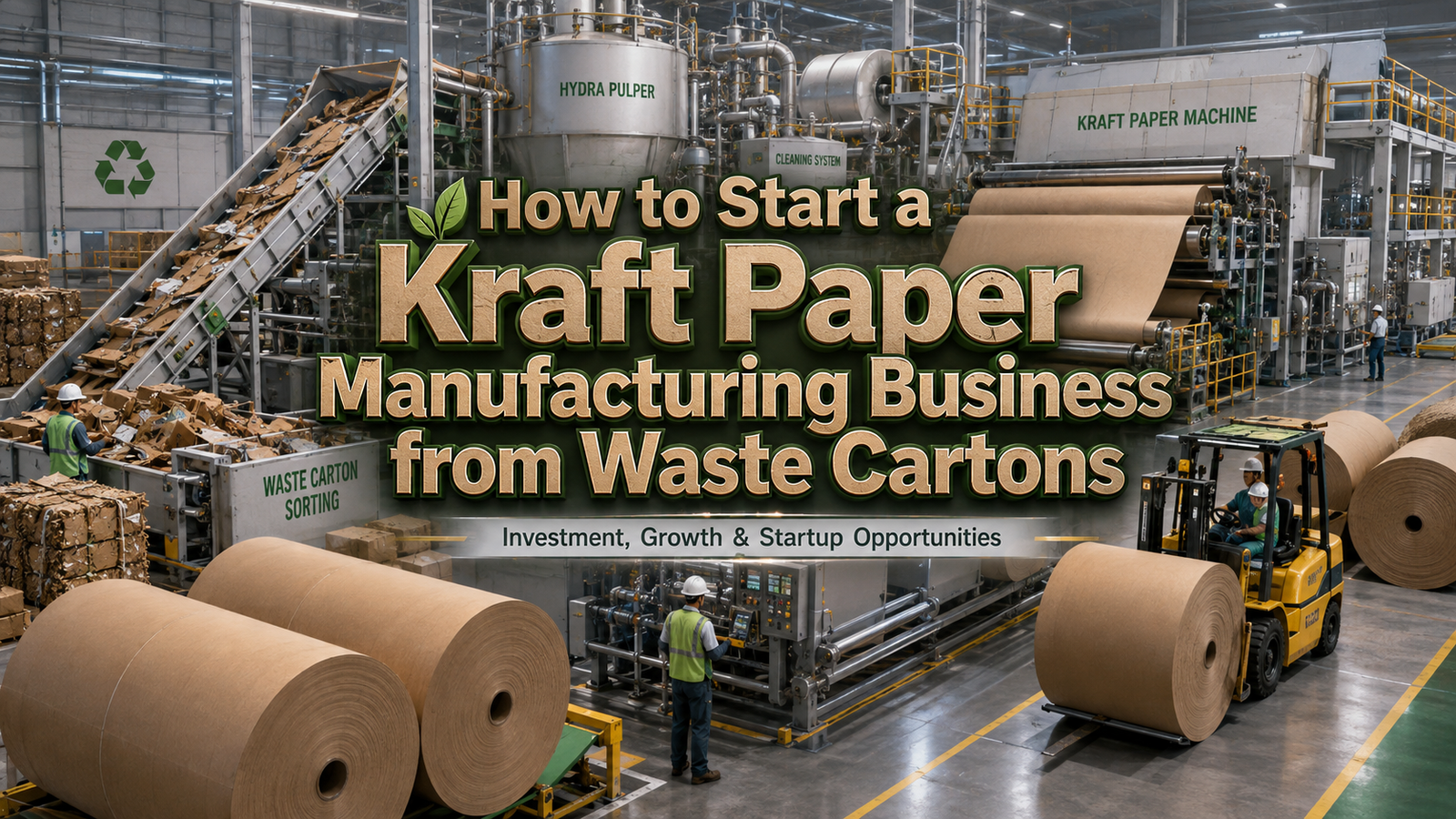
The value of every rejected carton is untapped and rests in the middle of a burgeoning manufacturing opportunity. One of the more viable and feasible business ventures for the entrepreneurs in the packaging sector entering India is the manufacture of kraft paper from waste cartons. The raw material is readily available, inexpensive, and available in increasing quantities, thanks to the surge of online shopping in Indian cities. The raw material is cheap, plentiful, and becoming even more plentiful, as e-commerce continues to fill Indian cities with cardboard. At the same time, virgin pulp usage, which was once the main source of fibre, is being replaced by recycled fibre due to its lower cost and reduced pollution. In the first place, this transition presents a market that seemed too capital intensive and out of reach to a first-generation entrepreneur.
Beginning, it might be a small-scale unit where old corrugated cartons are converted to kraft paper rolls and, with a small investment, it can access a market that is valued in thousands of crores. In this article, you will learn about the rationale behind the market, government help, some specific business ideas, and some actual case studies of Indian entrepreneurs who created successful businesses from recycled paper.
Read the Complete Book Here: Modern Technology of Pulp, Paper and Paper Conversion Industries
Why This Sector Deserves Your Attention
A Packaging Boom That Isn’t Slowing Down
With e-commerce, FMCG and export industry growing in tandem, packaging consumption keeps increasing in India. Kraft paper is the basic raw material for corrugated boxes, and about 85 percent of the cost of corrugated boxes is used to manufacture the kraft paper. This direct correlation means that sales of kraft paper increase with each increase in online retailing. Further, a greater number of Indian companies are looking to move away from plastic packaging materials towards paper-based packaging, adding to the demand.
Recycled Fibre Is Now the Smarter Choice
The energy used in making kraft paper from waste cartons is much less than that used in making virgin paper from wood pulp. It also requires less water and does not require the lengthy gestation period typical of a wood-based pulp mill. Consequently, a small recycled-fibre plant can get operational sooner and on a much lower capital investment than the virgin pulp plant. That’s the reason that paper conversion initiatives based on Old Corrugated Carton, or OCC, waste are becoming popular with initial generation entrepreneurs.
An Industry Still Dominated by Small Players
What is interesting is that none of the individual kraft paper mills in India accounts for more than 1% of the market. Despite the recent progress, the industry is still fragmented and hundreds of MSME scale businesses exist across various states like Gujarat, Uttar Pradesh and West Bengal. This is a bit good news for new players as no player is able to block entry and some pockets of regional demand stay under-served.
Import Substitution Adds Another Layer of Opportunity
Despite the fact that the country has enough capacity in various grades of paper and paperboard, it still imports a significant amount of these products every year. Thus, a well-managed kraft paper plant is not only an asset to local converters, it’s also helps to mitigate reliance on imports which policy-makers increasingly seek to diminish. The steady offtake means that entrepreneurs can expect a consistent supply of kraft paper, which is crucial for corrugators and box manufacturers, particularly when import prices are sensitive due to global freight costs and currency fluctuations.
Get Detailed Project Report (DPR): Paper Industry Business Guide
Government Policies and Incentives Fuelling This Business
PMEGP Makes First-Time Entry Easier
The Ministry of MSME has launched the Prime Minister’s Employment Generation Programme (PMEGP) by Khadi and Village Industries Commission (KVIC) which provides capital subsidy to new manufacturing units. The maximum limit for manufacturing projects is Rs 50 lakh and subsidy percentage varies from 15 percent to 35 percent based on the applicant’s type and area. An entrepreneur only requires a part of the investment as banks provide the rest. This scheme is ideally suited for a small kraft paper process, as many small kraft paper processes can fit into the project cost band.
Collateral-Free Credit Through CGTMSE
The business idea is not the reason that many first-time business owners stall out; it’s because they run into the collateral problem. To solve this problem, the Credit Guarantee Fund Trust for Micro and Small Enterprises (under the Ministry of MSME) is prepared to guarantee collateral-free loans of up to Rs 5 crore for qualifying manufacturing units. It means that even a kraft paper businessman, who does not have any mortgageable asset can have formal credit facility in the banks for acquiring machinery and working capital.
Udyam Registration Unlocks Everything Else
A unit has to apply for Udyam Registration with Ministry of MSME before applying to any Central Scheme. This registration is the entry point for the access for every other benefit for the MSMEs under PMEGP, CGTMSE, raw material assistance from NSIC etc. Applications cannot go anywhere without it. Luckily, there is no need to rush into the registration as it is free and doesn’t require any great effort to complete online.
Startup India and DPIIT Recognition
The start-up may qualify for recognition under Startup India by the Department for Promotion of Industry and Internal Trade if the venture introduces a new process like a proprietary de-inking or pulping process for waste carton. Preferential procurement norms provide tax benefits, ease in compliance and gives an edge to recognised startups in bids for government tenders.
Plastic Waste Rules Are Quietly Boosting Demand
The Plastic Waste Management Rules are implemented by the Extended Producer Responsibility norms and are being monitored by the Central Pollution Control Board and are encouraging brand owners and e-commerce companies to reduce the use of single-use plastic packaging. So, many companies are making the change to paper packaging, and kraft paper is at the heart of the change. New regulatory crackdown is decidedly in favor of today’s recycled kraft paper makers.
State-Level Incentives and Industry Support
In addition to central policies, most state policies also provide further incentives like stamp duty exemption, power tariff subsidy, and capital investment subsidy for MSME manufacturing units. Besides, industry associations such as Indian Paper Manufacturers Association are actively working for the industry at the policy front on issues like availability of raw materials, rationalisation of GST, etc. Thus, the entrepreneurs starting the business enjoy a support system from the Ministry of MSME, state industry departments and trade bodies all together.
Find the most profitable startup for your investment range
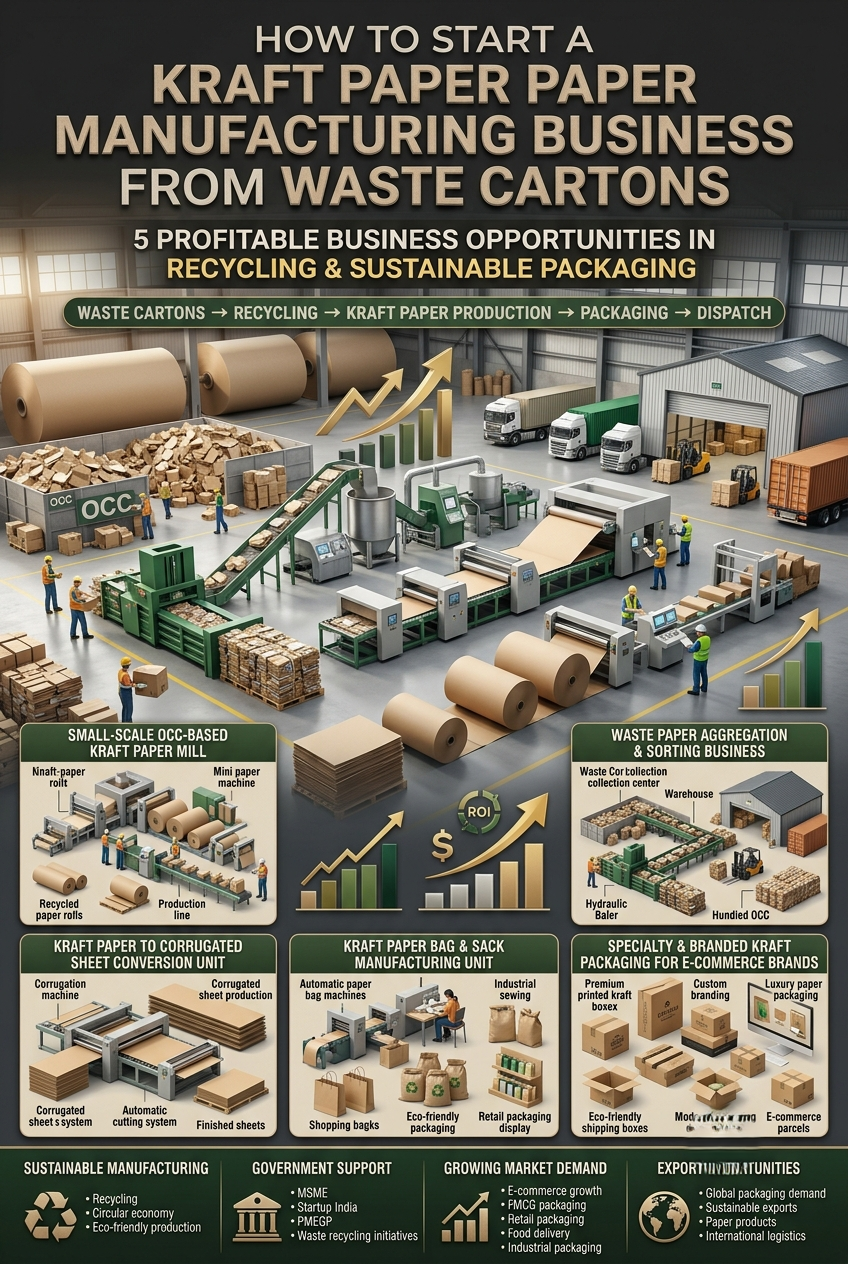
Multiple Business Ideas for Startups in Kraft Paper Manufacturing
Small-Scale OCC-Based Kraft Paper Mill
This is the core business concept in this area. A small mill, usually from 20 to 50 tonnes per day, operating with waste cartons and old corrugated boxes as the main raw material is set up by an entrepreneur. The process includes pulping, screening, and on a paper machine, the paper is formed into kraft paper reels. Location is important as raw material sourcing relies on scrap dealers and/or cartons aggregators, units close to industrial clusters or big cities that have a large amount of carton disposal are able to obtain a more consistent supply.
The investment cost for such a unit is generally in the crores of rupees and the payback period is between 3 to 5 years, assuming that it is able to lock-in its first anchor customers – like local box makers. This model is used for people who have some experience with paper trading or scrap aggregation and know where to get raw materials beforehand.
Waste Paper Aggregation and Sorting Business
Many successful entrepreneurs begin by expanding the company’s operations with part-time jobs, such as collecting and separating waste cartons for mills. This business requires considerably less capital (usually below Rs 30 lakh), and is based on the collection, baling and grading of OCC waste to the mills’ moisture and contamination specification. An aggregator who become consistent and good at the sorting process can get a good margin fast as they will be able to get a premium for the bales that contain low contamination levels. With time, this business can evolve naturally into an entrepreneur’s own pulping and paper business, if he or she develops good relationships with buyers and has a good insight into the supply chain.
Kraft Paper to Corrugated Sheet Conversion Unit
Instead of making the kraft paper from raw materials, an entrepreneur can purchase reels of kraft paper from the nearby mills and use them to make corrugated sheets and boxes. This downstream model requires significantly lower capital investment ranging from Rs 30 lakh to Rs 5 crore and has a short payback period, as the demand for packaging for the FMCG, pharmaceutical and ecommerce industries remain constant. Furthermore, it’s a model that works for first-generation entrepreneurs who wish to get a taste of the packaging business without committing to a complete pulp-and-paper operation immediately.
Kraft Paper Bag and Sack Manufacturing Unit
For food brands, grocery stores and cement companies, kraft paper bags are a popular plastic alternative. A manufacturing unit can source kraft paper reels locally and convert them into kraft paper bags and multi-wall sacks using relatively inexpensive bag-making machinery. As the Plastic Waste Management Rules continue to diminish the use of thin plastic bags, the demand for kraft paper bags continues to grow in retail and industrial products. For entrepreneurs looking to get into the market quickly, this option is ideal because they will require comparatively less amount of machinery and space as compared to a complete paper mill.
Speciality and Branded Kraft Packaging for E-Commerce Brands
The market for brands looking to communicate sustainability and print to a premium product has grown with ecommerce and D2C brands who want a kraft packaging that looks good and prints well. Entrepreneurs can build a niche business by producing printed and branded kraft packaging, such as mailer boxes and custom kraft cartons, and selling them directly to D2C brands instead of competing in the commodity market. This model will require design and printing skills and paper conversion skills, but will be a definite step up in margins from plain commodity kraft paper as it is not a paper for packaging functionality but a paper for branding.
Related Article: Kraft Paper from Waste Cartons: A Profitable Business Opportunity
Import–Export Opportunity Analysis
There is a fascinating story of the packaging paper business in India. Most grades of kraft paper can be made competitively at domestic mills but still huge amount of paper and paperboard is imported on an annual basis at the rate of thousands of crores of rupees. Industry bodies have long highlighted this as avoidable because India already has sufficient installed capacity for these grades. To a new player, that import deficit will offer an actual room for growth, especially in higher burst factor kraft grades for heavy duty and export packaging.
The opportunity on exports is also very promising. Indian mills offer competitively priced kraft paper compared to European and Chinese suppliers, so buyers in neighboring South Asian markets import it from India. Also, there is a growing demand for recycled content packaging from buyers around the world, and Indian kraft paper from waste cartons can easily meet that demand.
But exporters have to consider the grade specification and packaging requirement of the target country and the moisture control during the production process directly influences the strength consistency which the international buyers do so much testing. Therefore, entrepreneurs planning to manufacture kraft paper for export should invest in quality testing equipment from the beginning and obtain certifications such as FSC. Many international buyers now consider FSC certification a basic requirement rather than an added advantage.
In sum, the import-export equation has come out pro-new-manufacturing capacity. Export markets reward consistent quality, while strong domestic demand absorbs base production, allowing manufacturers to export higher-quality grades at better profit margins. This 3-way opportunity is not available in many categories of packaging at the same time.
Indian MSME Success Stories
Pakka Limited, Formerly Yash Papers — Ayodhya
KK Jhunjhunwala established this company with a small paper mill based on waste from sugarcane and low-grammage kraft paper. For the start of the machinery, his wife sold her jewellery, and for the next 20 years or so the company developed into a viable kraft paper manufacturer. His son, Ved Krishna, presided during a challenging era before making the company a viable packaging business with the launch of a compostable tableware brand as well as the existing paper business. The company currently trades on the stock exchange, generates hundreds of crores in annual revenue, and exports to over a dozen countries. The development process highlights the fact that it is possible to grow a small kraft paper mill, based on recycled and agro-waste fibre, into an internationally recognised sustainable packaging company over the years.
The Morbi Kraft Paper Cluster — Gujarat
Morbi, better known for ceramics, quietly became one of India’s strongest kraft paper manufacturing hubs, home to dozens of MSME-scale mills that convert waste paper into kraft reels for the domestic packaging industry. Entrepreneurs in this cluster, many from local packaging and trading backgrounds, pooled machinery knowledge and built a dense ecosystem where raw material sourcing, mill operation, and downstream conversion all happen within a tight geographic radius. This cluster model offers a repeatable lesson for new entrants: proximity to raw material aggregators and buyer clusters cuts logistics costs dramatically and improves margins for MSME-scale units.
What These Stories Teach New Entrepreneurs
Both examples share a common thread. Neither started with massive capital, and both grew through patient reinvestment, consistent quality, and a willingness to adapt product lines as market needs shifted. For someone starting today, the lesson stays simple: begin at a scale you can manage well, secure raw material relationships early, and reinvest profits into better machinery rather than chasing rapid, unplanned expansion.
How NPCS Helps You Plan This Business the Right Way
Many entrepreneurs evaluating this business ask a fair question: how do they know if their specific project, at their chosen scale and location, will actually turn a profit? This is where a proper feasibility study earns back its cost many times over. We at Niir Project Consultancy Services (NPCS) prepare Market Survey cum Detailed Techno-Economic Feasibility Reports for entrepreneurs planning to set up kraft paper and other manufacturing units. Our reports cover the complete manufacturing process, market research and demand analysis, process flow diagrams, machinery and raw material details, product mix planning, and full project financials with profitability analysis. Rather than relying on assumptions, an entrepreneur working from a properly researched feasibility report walks into bank discussions and government scheme applications with far greater confidence and credibility.
Market Size and Cost Snapshot: Kraft Paper from Waste Cartons
Before finalising an investment decision, it helps to look at the numbers side by side. The table below summarises typical capacity, investment, and payback ranges across the different business models discussed in this article. These figures stay indicative and vary by location, machinery vendor, and raw material cost, so a proper feasibility study remains essential before committing capital.
| Business Model | Typical Capacity | Approx. Investment | Payback Period | Primary Raw Material |
| Waste Paper Aggregation & Sorting | 5–15 tonnes/day | Rs 10–30 lakh | 1–2 years | OCC waste cartons |
| Small OCC-Based Kraft Paper Mill | 20–50 TPD | Rs 3–15 crore | 3–5 years | Waste cartons, OCC |
| Kraft Paper to Corrugated Sheet Conversion | Order-driven | Rs 30 lakh – 5 crore | 2–4 years | Kraft paper reels |
| Kraft Paper Bag / Sack Manufacturing | 2–8 tonnes/day | Rs 40 lakh – 2 crore | 2–3 years | Kraft paper reels |
| Branded / Speciality Kraft Packaging | Order-based | Rs 50 lakh – 3 crore | 2–4 years | Kraft paper, print inputs |
Frequently Asked Questions
How much investment does a small kraft paper unit need?
It depends heavily on scale. An aggregation and sorting business can start under Rs 30 lakh, while a full 20-50 TPD manufacturing mill typically needs a few crores. Downstream conversion units, such as corrugated sheet or bag manufacturing, sit somewhere in between these two extremes.
Is Udyam Registration mandatory before applying for schemes like PMEGP?
Yes. Udyam Registration now works as a prerequisite for nearly every central MSME scheme, including PMEGP, CGTMSE, and NSIC raw material assistance. Applications without a valid registration simply don’t get processed.
What raw material quality do kraft paper mills expect from waste cartons?
Mills generally expect moisture below 10 percent and non-paper contamination below 2 percent. Meeting these standards consistently is what separates a profitable aggregator from one struggling with rejected loads.
Can a first-generation entrepreneur with no manufacturing background enter this business?
Yes, and many successful players started exactly this way. Beginning with a smaller model, such as waste paper aggregation or downstream conversion, lets a new entrepreneur learn the business before committing to full-scale manufacturing.
Does this business qualify for collateral-free loans?
In many cases, yes. CGTMSE guarantees collateral-free loans up to Rs 5 crore for eligible manufacturing units, and this covers most small and medium kraft paper projects comfortably.
What is the biggest operational risk in this business?
Inconsistent raw material supply and weak quality control usually cause the most trouble. Building reliable relationships with waste paper aggregators and investing in basic quality testing early prevents most of these problems.
Conclusion
Kraft paper manufacturing from waste cartons sits at a rare intersection of strong demand, supportive government policy, and a genuinely lower entry barrier compared to most paper industry segments. Entrepreneurs don’t need to compete with large integrated paper companies to succeed here; the market rewards MSME-scale players who understand local supply chains and maintain consistent quality. With schemes like PMEGP and CGTMSE reducing the funding barrier, and regulatory shifts away from plastic packaging strengthening demand, the timing genuinely favours new entrants. As with any manufacturing venture, success ultimately depends on getting the fundamentals right: accurate project sizing, dependable raw material sourcing, and a realistic financial plan grounded in an actual feasibility study rather than assumptions. For entrepreneurs willing to start focused and scale steadily, this remains one of the more grounded business ideas available in India’s packaging economy today.