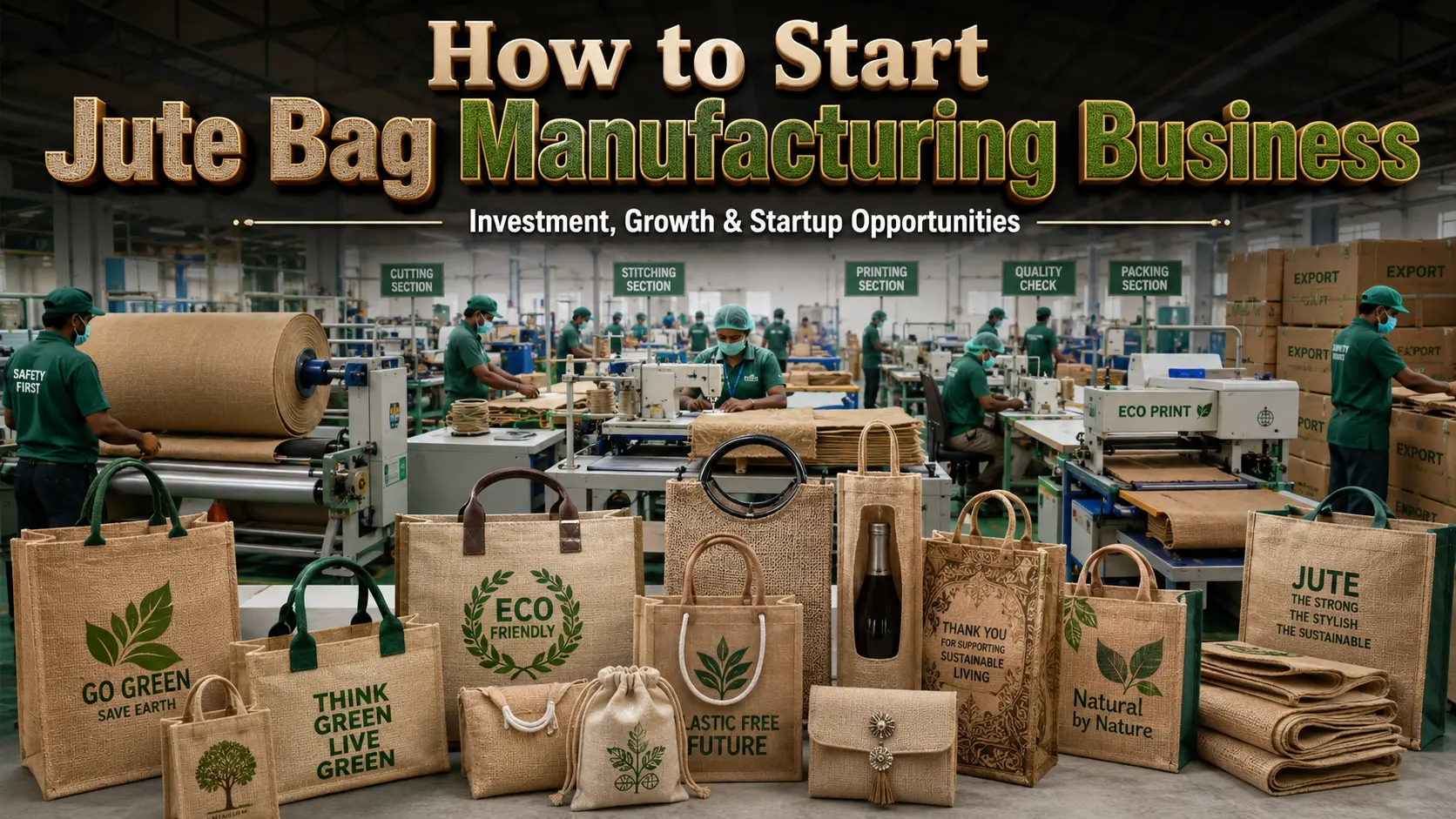

Jute Bag Manufacturing Business
Jute bag industry is one of the most interesting business ideas in sustainable production these days because it has a huge domestic demand, has gained some momentum in export, and has been well supported by the government. Rare find that can cater to the everyday retail market and premium export market too, as they are evaluated by the entrepreneurs for entering the packaging industry. Furthermore, the regulations on single-use plastics have become a gamechanger in India and worldwide, impacting consumer and business choices forever. This is not just an environmental story for first generation founders and MSME investors. It’s a viable business proposition with quantifiable margins and expanding institutional need.
Why the Jute Bag Industry Is Growing Faster Than Expected
India is the largest producer of raw jute and exporter of jute goods in the world with more than 80% of the world’s jute goods exported from it. This natural geographical and agricultural advantage directly converts to cost competitiveness for the manufacturers. Furthermore, the global trend of making everything biodegradable has brought a steady demand from retail stores, supermarkets, fashion retail brands and corporate-gifting firms. In addition, the ban on plastic carry bags imposed by the Government has made jute bags essential for institutions than a mere means of living. The result is that the demand is not seasonal or trend-driven, it is structurally part of the chain.
The relatively simple manufacturing processes, the availability of raw materials and the low barriers to entry for small-scale producers are beneficial for the profitability of this sector. Likewise, there are several price points for the product, ranging from grocery bags to custom-branded and export-quality totes, providing flexibility for entrepreneurs to target specific customer bases without resorting to significant retooling.
Get Detailed Insights from This Book: The Complete Book on Jute & Coir Products (with Cultivation & Processing)
Government Policies and Incentives Supporting Jute Bag Startups
The Government of India has always been supportive of jute being a strategic agro-industrial crop. The National Jute Board (NJB) under the Ministry of Textiles, actively encourages jute market development and diversification. Financial assistance can be availed to the entrepreneurs under the Jute-ICARE scheme for improved cultivation and value-added product development. In addition, the MSME Ministry’s Credit Guarantee Fund Trust for Micro and Small Enterprises (CGTMSE) offers collateral-free loans of up to ₹2 crore to eligible jute bag manufacturing units. For details, please check with National Jute Board, Ministry of MSME portal.(Jute Bag Manufacturing Business)
Further, foodgrains and sugar are subject to jute packaging under the Jute Packaging Materials (Compulsory Use in Packing Commodities) Act which has ensured institutional purchase of jute packaging for the manufacturers. Jute products are eligible for preferential treatment under ‘Make in India’ initiative in government procurement. The PLI scheme for textiles also gives benefits to diversified jute products. In addition, duty drawback schemes and benefits under the Foreign Trade Policy, which is administered by DGFT, can be availed by the exporters.
Multiple Business Ideas for Startups in Jute Bag Manufacturing
1. Standard Grocery and Retail Jute Bag Unit
This is the easiest place for new business owners to start. The standard grocery bags are those which are of small size and are usually made from small to large tote bags to carry load which can be started with an outlay of Rs. 8 to 15 lakh as it requires machine, raw materials (jute fabric) and stitching units along with working capital. Major customers are local supermarkets, kiranas planning to abandon plastic usage and government run fair-price shops. This means that sales cycles are short, and order volumes are manageable. Input procurement is simple as the raw jute fabric is directly collected from the mills in Kolkata city or from the State procurement agencies. The margins on standard bags are usually 25-35% and in this case it would be a profitable choice from the first year of operation.
2. Custom-Branded and Corporate Gifting Jute Bags
Jute bags are getting much popularity as a gifting and branding media among corporate India. Companies purchase custom printed jute bags for their annual events, product launches, trade fairs and employee gifting. This segment, however, does call for screen printing or digital printing ability along with basic bag making. So, this means capital investment is a bit more – ₹12 to ₹25 lakh – and the margin profile is substantially better. Custom bags are priced 40-60 percent higher than their unbranded counterparts. Furthermore, if a company that is satisfied with the company’s services orders products again, it establishes regular revenue flows. This model will be especially rewarding for entrepreneurs who are design-literate and have a sales-oriented approach to B2B channels. Main target sectors are event management, brands in the FMCG sector, NGOs and educational institutions.(Jute Bag Manufacturing Business)
Get Detailed Project Report (DPR): Jute and Jute Based Project, Oil, Coir, Shopping Bags Projects
3. Export-Oriented Premium Jute Bag Manufacturer
The international premium jute bag market, especially from Europe and North America, provides premium price of 3 to 5 times as compared to domestic market. The high-end customer base is from Germany, France, the UK and US for fashionable jute totes, wine bottle carriers and decorative gift bags. Hence, an export-oriented unit needs extra investment in quality finishing, embroidery/patch work capacity as well as international buyer’s specification. The estimated cost of the entire project is approximately ₹20 to ₹40 lakh. But dealing with export houses or registering on sites such India Mart and TradeIndia can drastically shorten the market entry process. The Jute Manufacturers Development Council (JMDC) also provides exporters market intelligence and connections with buyers.
4. Jute Bag Job Work and Contract Manufacturing
If you are an entrepreneur with less amount of capital, you can start contract manufacturing or job work for a well-known brand, as it is less risky. In this model, the main brand will supply raw material, design specifications and branding, and the unit will supply cutting, stitching and finishing services for a per piece fee. This helps to reduce risk of working capital and to secure more predictable cash flow. Additionally, this process allows new entrepreneurs to develop skills in operation, machine productivity and quality standards prior to going into business as a separate brand. The initial setup cost for a simple job work unit can be anywhere between ₹5 lakh to ₹8 lakh. Plus, good working relationships created during the contract phase can lead to direct supply contracts.
5. Online D2C Jute Bag Brand
The concept of establishing a direct-to-consumer brand for artisan and design bags on Amazon, Flipkart and other ecommerce platforms is a modern idea in the traditional business. Consumers are looking for green, beautiful substitutes to plastic and synthetic bags. As a result, top-notch jute products make it to the top of the charts online with good photography and storytelling. Then, on D2C platforms, the low order minimization options enable entrepreneurs to try out lines of products before making the investment in mass production. The investment range for this model is generally ₹5 to ₹12 lakh, a substantial part of which goes into branding, packaging, and online marketing, as opposed to extensive manufacturing facilities.(Jute Bag Manufacturing Business)

Import–Export Opportunity Analysis
The export of jute goods is a well-developed sector in India which generates revenues. The key countries of export are the U.S., the U.K., Germany, France and Australia. One of the emerging segments of diversified jute goods exports are jute bags, especially the shopping bags, promotional bags and wine carriers. The Agricultural and Processed Food Products Export Development Authority (APEDA) and the Directorate General of Commercial Intelligence and Statistics (DGCIS) data also reflect year-on-year growth in exports of jute goods.
India’s imported demand is not of much significance as there is very little competition from other markets too. At the low end, though, design innovation and finishing from Asian countries such as Bangladesh and China are competitive. Hence, Indian manufacturers facing the path of value addition and design intensive products have a structural edge in global bidding. Also, FIEO (Federation of Indian Export Organisations) is offering export facilitation services, which are relevant to exporters of jute products, like Buyer-Seller meets, Market Access Programmes etc.
Instantly discover profitable startup opportunities tailored for you
Indian MSME Success Stories in Jute Bag Manufacturing
Gloster Limited – From Commodity to Premium
B.K. Birla Group’s promoted Gloster Limited is a name synonymous with quality jute manufacturing in India for a long time. But its strategic move towards diversified and value-added jute products, such as bags, geo-textiles, and composite products, shows how jute manufacturers, who have long dominated the jute industry, can reinvent themselves to meet the modern market needs. New entrepreneurs should invest in product diversification early in their business. This strategy helps them reduce the impact of commodity price cycles and maintain premium pricing.
Aarbee Structures Pvt. Ltd. – Export-First Strategy
The company, Aarbee Structures, of West Bengal, carved out its niche in the market by bypassing middlemen and hitting the retailers in Europe straight. The emphasis the founder put on quality certification, compliance documentation and buyer relationship management is reaping rewards with consistently strong order books. This has now led to this company having the luxury of premium per unit pricing from all its European customers. Build export readiness and its impact on revenue per unit and domestic market pricing pressure is evident: it comes in through certifications, quality, and buyer communication.
D2C Jute Entrepreneurs – Brand Building at Scale
There are many small business owners who have achieved success in creating D2C jute bag brands, for reaching urban consumers throughout India via Instagram and Amazon. They have succeeded in securing three-to-four-fold higher prices for their product, which is a blend of traditional jute making skills and modern visual branding for jute bags, as compared to commodity bags. Furthermore, they have low overheads as they lean out their production processes and frequently subcontract their stitching to local self-help groups, which provides flexibility. This case is a good learning example for those who are in the process of establishing their business as it teaches them that brand story and distribution channels are as important as the efficiency of production.
Related Article: Agro-Processing in Jute: Supply Trends, Market Gaps & Profitable Startup Opportunities in India
Planning Your Jute Bag Business with Expert Feasibility Support
Due to this, thorough feasibility studies are a prerequisite in any manufacturing venture before investing capital. We at Niir Project Consultancy Services (NPCS) offer professional consulting on the preparation of Market Survey cum Detailed Techno-Economic Feasibility Reports (DPRs) for start-up of new industries or business. Our reports for Jute Bag Manufacturing Units feature in-depth knowledge of manufacturing processes, market research and demand analysis, process flow diagram, product mix and capacity planning, machinery information and raw material details, complete project financials with profitability analysis. Our goal is to assist entrepreneurs in assessing what is feasible, profitable, and sustainable, before putting in the investment. Therefore, the founders will make better decisions and will not make any unnecessary mistakes at the planning stage.
Jute Bag Manufacturing: Key Business Parameters at a Glance
| Parameter | Small Scale Unit | Medium Export-Oriented Unit |
| Project Cost | ₹8–15 Lakh | ₹20–40 Lakh |
| Monthly Production | 20,000–40,000 bags | 80,000–1,50,000 bags |
| Primary Raw Material | Jute fabric/hessian cloth | Jute fabric, liners, jute twine |
| Gross Margin | 25–35% | 35–55% (export premium) |
| Key Machinery | Cutting table, sewing machines | Auto stitching, screen printing, QC line |
Frequently Asked Questions (FAQ)
Q1. How much investment is needed to start a jute bag manufacturing unit?
The cost of a small-scale basic unit may start from as low as Rs.8 to Rs.15 lakhs, which includes the cost of the machines, the initial stock of raw material and working capital. For an export-oriented or custom printing unit, the investment will be in the range of ₹20 lakh to ₹40 lakh. The investment amount depends on product, manufacturing capacity and customer.
Q2. Which licences and registrations are needed?
The MSME/Udyam registration, GST registration, trade license from the local municipal body and pollution NOC from the State Pollution Control Board are the basic licenses that any entrepreneur requires. An Import Export Code (IEC) issued by DGFT is required for export units.
Q3. What places can I get raw jute fabric from?
The raw jute fabric is mainly produced from the mills of Kolkata, Howrah and Murshidabad districts of West Bengal. Several national-level suppliers also offer these raw materials through platforms such as IndiaMart. State procurement agencies occasionally offer small units at lower prices.
Q4. Is this business suitable for starting at home or a small workshop?
Yes. Job work units or D2C brand building ventures can begin from a small workshop having three to five sewing machines. For regular production or export, entrepreneurs should use a well-ventilated facility with at least 500 to 1,000 square feet to ensure efficient operations.
Q5. Which is the government scheme to help jute bag entrepreneurs?
CGTMSE (collateral free loans), Jute-ICARE scheme, Credit Linked Capital Subsidy Scheme (CLCSS) by the Government of India and subsidy from the National Jute Board are the relevant schemes. Further, Duty Drawback schemes and incentives from DGFT are available for exporters.
Q6. Is there scope for women entrepreneurs in this sector?
Absolutely. Women-led SHG (Self Help Group) units have already a strong legacy in the jute bag industry, in West Bengal, Odisha and Bihar. The government programmes under WCD and NRLM particularly encourage the women entrepreneurs in agro-processing and textile manufacturing activities, such as jute bag manufacturing.
Conclusion: A Business Built for the Future
Jute bag manufacturing combines regulatory tailwinds, export demand, and authentic sustainability credentials — a combination few manufacturing sectors can match simultaneously. Moreover, the multiple business ideas within this sector — from standard grocery bags to premium export products to branded D2C ventures — ensure that entrepreneurs across different capital levels and risk profiles can find a viable entry point. Consequently, this is one of the more structurally sound investment decisions in agro-based manufacturing today. Therefore, founders who invest in proper feasibility analysis, machine selection, and market positioning before launch will find this sector highly rewarding over a three- to five-year horizon.