
Green Hydrogen Manufacturing Business
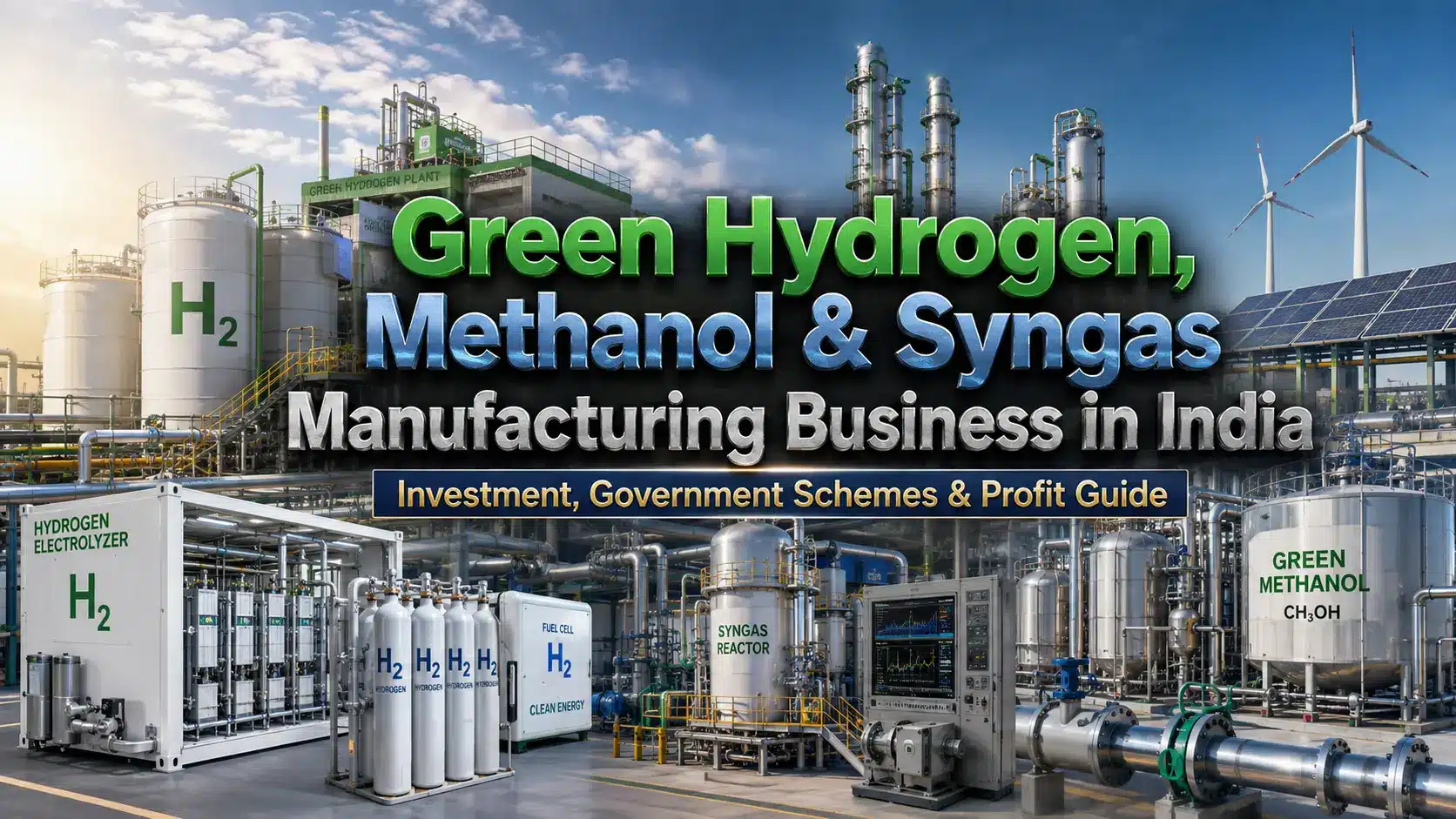
India’s energy mix is rapidly changing. This transformation represents a golden opportunity for the entrepreneurs to avail the actual business opportunities, and it is mainly focused on the conversion of syngas, methanol, hydrogen and DME. The conversion converts coal, biomass, natural gas and renewable to cleaner fuels, clean chemicals and cleaner industrial feedstocks through four offtakes. This sector provides a combination of things which is rare in the world for a first-generation entrepreneur or an MSME planner — backing from the government, domestic demand and export potential.
This article explores the sector’s appeal, highlights policies that support new entrants, identifies the plants and products suitable for this model, and showcases how Indian manufacturers have successfully proven its effectiveness.
Why This Sector Deserves Your Attention
There are also existing large markets for grey hydrogen and conventional methanol in India. Hydrogen is used in the refinery for desulphurisation. The syngas is used in fertiliser plants to produce ammonia. Chemical units employ methanol for solvent, and feedstock to produce formaldehyde, acetic acid, and MTBE. But the true opportunity is in the transition that is taking place.
India gets a significant import of crude oil and LPG. The government is looking to replace imported fuel with fuel produced domestically by converting methanol, hydrogen and DME, due to this dependency. This guarantees pull-demand for new manufacturing capacity. Coastal shipping is also transitioning to green methanol as a ship’s fuel; many ports have started their bunkering trials.
Meanwhile, the cost curve is on the other side and is working in favour of the industry. Green hydrogen production cost will also be reduced in the coming years as more and more electrolysers are produced in India. In the meantime, traditional syngas-to-methanol processes based on coal, biomass, or natural gas are commercially viable today and an entrepreneur doesn’t need to wait for green tech to become more mature before playing the market. New manufacturers can take a pragmatic approach with a phased implementation: conventional or bio-based first, followed by green capacity.
There’s also export potential. Importing countries, such as Japan, South Korea and the European Union, are interested in green ammonia and green methanol imports, while India’s coastline provides a logistics edge for local producers as opposed to those on land. This is not a usual scenario in Indian manufacturing today for an MSME investor, who can enjoy the assured domestic pull-demand coupled with growing export interest.
Business Ideas at the Core of This Opportunity
Let’s start off by stating that the business concepts in this industry are not restricted to huge petrochemical plants. Entrepreneurs can easily launch a well-planned MSME through small and mid-sized plants, decentralised biomass-to-syngas facilities, methanol-blending units, or DME-bottling plants.
Government Policies and Incentives Supporting New Entrants
The support for this is particularly substantial and that is important for anyone creating a project report or applying for bank finance.
The National Green Hydrogen Mission, under the Ministry of New and Renewable Energy, is the ‘anchor scheme’. It requires a capital investment of ₹19,700 crore and the project is aimed at developing a 5 million tonne-green hydrogen production capacity by 2030. SIGHT (Strategic Interventions for Green Hydrogen Transition programme) has two components: a) incentives for manufacturing of electrolysers and b) incentives to green hydrogen producers on a pay-as-you-produce basis, said to be of the order of ₹50 per kg for initial years of a project.(Green Hydrogen Manufacturing Business)
The government has already announced a separate PLI scheme for electrolyzer manufacturers and selected more than a dozen companies to establish electrolyzer plants with a combined annual capacity of thousands of megawatts. This is relevant to entrepreneurs, as it indicates that hydrogen project component supply chains are becoming local, leading to lower capital costs as time goes on.
NITI Aayog’s Methanol Economy programme encourages the use of DME in LPG and the development of transport fuels based on DME (M15, M85) in a specific context, namely methanol and DME. This further boosts the demand side of the new methanol capacity as the Ministry of Road Transport and Highways has already issued notifications for fuel standards of these blends.
Related Article: Green Hydrogen Production in India: The Next Trillion-Rupee Opportunity for Entrepreneurs
In addition to these sector schemes, there is also support for MSMEs in general, which should be taken up. The Ministry of MSME’s Credit Guarantee Scheme of MSME, the Udyam registration benefits, and state level capital subsidies including Uttar Pradesh, Gujarat, Odisha, Rajasthan and Maharashtra can have a positive impact on equity contribution of a new project. Some states also exempt Inter-State Transmission System (ISTS) charge for renewable energy consumption in green hydrogen projects till 2030, thereby reducing operating costs for electrolysers.
Therefore, when creating a DPR for this sector, map each applicable scheme to the selected technology route. The incentive stack can vary significantly between a coal-based syngas plant and a renewable-powered green hydrogen plant.
Multiple Business Ideas for Startups and MSMEs
All concepts of the following projects are related to the syngas–methanol–hydrogen–DME value chain. These can all be scaled to MSME size in appropriate capacity and feedstock selection.
Biomass-to-Syngas Gasification Unit
Biomass gasification plant is a system that produces syngas by partially combusting waste products like rice husk, bagasse or cotton stalk under controlled conditions. This is a good solution for high crop residue burning areas as it transforms a disposal issue into a feedstock opportunity. The syngas generated is suitable for use from a thermal energy perspective, a gas engine/gas turbine power generation perspective, or the production of methanol. Since the raw material is cheaper in agricultural areas, this route has the potential to achieve quicker returns than routes involving fossil fuel. Transportation costs significantly affect project economics. Therefore, entrepreneurs should carefully assess the availability of residue within a 25–30 km radius before entering this sector.
Get Detailed Project Report (DPR): Biomass, Biofuel & Energy Development Projects
Small-Scale Methanol Production from Natural Gas or Coal Syngas
A traditional gas- or coal-based methanol plant remains one of the most viable options because it uses proven technology and serves an established off-take market. The principal use for methanol is in manufacturing formaldehyde, in the paint and adhesive industries and, more recently, in fuel blending programmes. A medium sized unit (100-300 tonnes/day) can be used to serve chemical clusters in regions without direct competition with larger public sector producers. This continues to be a proven and de-risked entry point for entrepreneurs in gas connected industrial corridors, especially in Gujarat and coastal Andhra Pradesh into the broader gas economy.
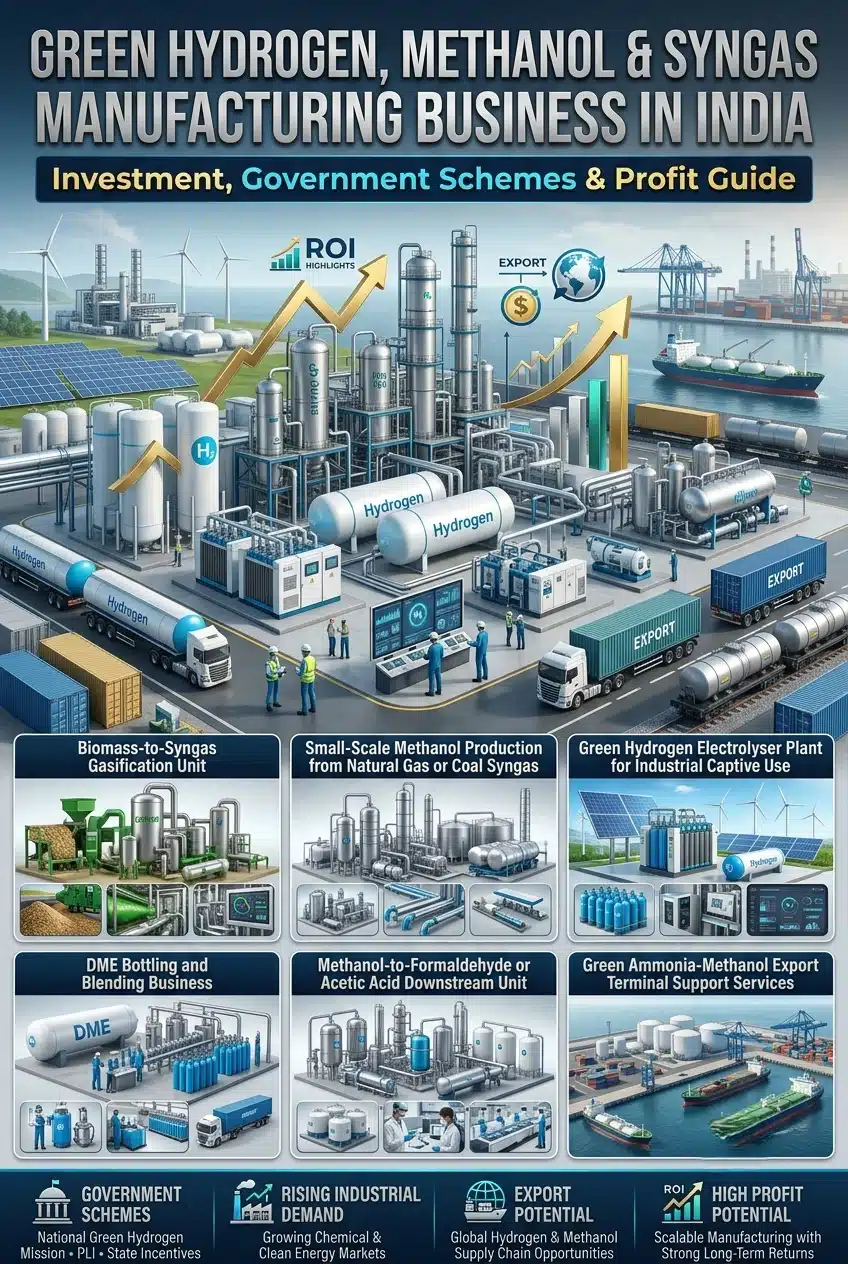
Green Hydrogen Electrolyser Plant for Industrial Captive Use
Rather than building a merchant hydrogen plant from day one, many new entrants are finding better economics in captive supply models. A steel re-rolling unit, a refinery, or an ammonia plant that currently buys grey hydrogen can host a co-located electrolyser project and supply hydrogen directly through pipeline, avoiding transport and storage costs altogether. This model also qualifies for SIGHT production incentives, administered through the Solar Energy Corporation of India, if the buyer commits to a long-term offtake agreement. For an entrepreneur, partnering with an existing industrial consumer removes much of the market risk that usually makes green hydrogen ventures difficult to finance.(Green Hydrogen Manufacturing Business)
Read the Complete Book Here: Solar PV Power and Solar Products Handbook
DME Bottling and Blending Business
DME can be blended with LPG at ratios of up to 20 percent without changing existing cylinders or stoves. This compatibility makes DME one of the most accessible entry points in the entire value chain. A regional LPG bottling company can add a DME blending unit to its existing infrastructure, sourcing DME from a merchant methanol-to-DME converter. Because the underlying policy direction from NITI Aayog explicitly supports this blending model, an entrepreneur entering now positions the business ahead of an anticipated demand curve, rather than chasing an already-saturated market.(Green Hydrogen Manufacturing Business)
Methanol-to-Formaldehyde or Acetic Acid Downstream Unit
For entrepreneurs who prefer chemical manufacturing over fuel production, a downstream methanol-consuming unit offers a lower capital route into the same value chain. Formaldehyde, used heavily in plywood, laminate, and resin industries, and acetic acid, used in paints, textiles, and food processing, both draw directly on methanol as feedstock. Locating such a plant near an existing regional methanol supplier, rather than integrating backward into methanol production, reduces both capital cost and technical risk while still capturing strong demand from India’s expanding construction and packaging sectors.
Green Ammonia-Methanol Export Terminal Support Services
Not every opportunity in this sector requires owning a production plant. As green hydrogen hubs develop along India’s western and eastern coastlines, ancillary businesses such as storage tank fabrication, specialised logistics, testing and certification services, and bunkering support are opening up. For an entrepreneur with engineering or logistics experience but limited capital for a full production plant, these service-layer businesses offer meaningful entry into the sector’s growth without the capital intensity of a manufacturing unit.(Green Hydrogen Manufacturing Business)
Import–Export Opportunity Analysis
India’s trade position in this sector is unusual, because the country is simultaneously a large importer of crude-linked fuels and an emerging exporter of green derivatives.
On the import side, India brings in a significant share of its LPG and a smaller but growing volume of methanol, largely from Gulf and Southeast Asian producers. Every tonne of domestic methanol, hydrogen, or DME capacity added directly displaces this import bill, which is precisely why the Department for Promotion of Industry and Internal Trade frames the National Green Hydrogen Mission as an energy security programme, not just a climate initiative.
On the export side, Japan and South Korea have both signalled long-term interest in importing green ammonia and green methanol to decarbonise their power and shipping sectors. The European Union’s carbon border rules are also encouraging EU shipping companies to adopt green marine fuels. Indian ports along the western coastline are well positioned to meet this growing demand. Deendayal Port in Gujarat has already completed a shore-to-ship methanol bunkering trial, signalling that export infrastructure is moving from planning into execution.
Industry bodies such as FICCI have also flagged this coastal advantage in their trade policy submissions. For an MSME, direct export may not be realistic at first. However, supplying certified feedstock or components to larger green hydrogen hub developers in Andhra Pradesh, Gujarat, and Rajasthan offers an indirect but genuine way to enter this export-linked market.
Find the most profitable startup for your investment range
Indian MSME Success Stories Worth Studying
Learning from entrepreneurs who have already built successful businesses in adjacent chemical and energy segments offers useful lessons for anyone entering the syngas-methanol-hydrogen space.
Deepak Fertilisers and Petrochemicals Corporation, promoted by the C.K. Mehta family, began as a single-product fertiliser company and steadily diversified into technical ammonium nitrate and specialty chemicals. The promoters consistently reinvested profits into backward integration, securing their own feedstock supply rather than depending entirely on the open market. For a new entrant in the methanol or hydrogen space, this is a critical lesson: controlling feedstock, whether biomass, natural gas, or renewable power, reduces margin volatility far more than chasing the highest possible plant capacity.
Gujarat Narmada Valley Fertilizers and Chemicals (GNFC), though a larger public sector-linked entity, built its early growth on efficient syngas-based ammonia and methanol production in a gas-rich cluster. Its decision to locate close to feedstock and port infrastructure, rather than close to the final consumer market, is a model smaller entrepreneurs can replicate at MSME scale.(Green Hydrogen Manufacturing Business)
Praj Industries, founded by Pramod Chaudhari, started as a smaller engineering company and grew into a global leader in biomass-based fuel and syngas technology by focusing on process engineering rather than large-scale capital deployment. Chaudhari’s approach of licensing and exporting technology, rather than only running captive plants, shows entrepreneurs an alternative growth path: expertise and process know-how can be as valuable a business as the plant itself.
All three examples highlight the importance of patiently developing a feedstock strategy and diversifying downstream operations after proving the core process. They also show why businesses should avoid expanding a single product line too quickly.(Green Hydrogen Manufacturing Business)
About NPCS: Turning This Opportunity Into a Bankable Project
We at Niir Project Consultancy Services (NPCS) provide professional consulting for the preparation of Market Survey cum Detailed Techno-Economic Feasibility Reports (DPRs) for setting up new industries or businesses, including syngas, methanol, hydrogen, and DME projects. Our reports include detailed manufacturing processes, market research and demand analysis, process flow diagrams, product mix and capacity planning, machinery and raw material details, and complete project financials with profitability analysis. Our objective is to help entrepreneurs evaluate feasibility, profitability, and long-term scalability before investing, so that capital goes into projects with a realistic path to commercial success.
Market and Cost Snapshot
| Parameter | Grey/Conventional Route | Green Route |
| Hydrogen production cost | ₹150–₹200 per kg | ₹397–₹560 per kg |
| Key feedstock | Natural gas, coal, naphtha | Renewable power, water |
| Typical MSME plant scale | 50–300 TPD (methanol) | 1–10 TPD (hydrogen) |
| Primary incentive route | State capital subsidy, MSME schemes | SIGHT production incentive, electrolyser PLI |
| Main offtake sectors | Chemicals, fertiliser, adhesives | Refining, shipping fuel, export |
| National target | Existing installed base | 5 MMT green hydrogen capacity by 2030 |
Frequently Asked Questions
Is a small-scale methanol or syngas plant viable for a first-time entrepreneur?
Yes, I am referring mainly to biomass-based and traditional gasification routes. Indian companies have developed these technologies, and machine suppliers are ready to establish plants in India. Local chemical clusters also provide reliable off-take opportunities.
How much capital does a green hydrogen electrolyser project typically need?
Scale of Investment Capital Investment requirement scales vary, but an existing captive-use electrolyser supplying an existing industrial consumer tends to require lower capital Investment than an independent merchant plant, due to the omission/reduction of costs associated with storage, compression and transportation Infrastructure.
Do I need a chemical engineering background to enter this sector?
No. Many successful entrepreneurs in this space partner with process licensors and equipment suppliers for the technical design, while focusing their own expertise on feedstock sourcing, plant execution, and offtake agreements.
Which government scheme should I apply for first?
That depends on the technology route. A green hydrogen project should target SIGHT incentives and state renewable energy subsidies, while a conventional methanol or DME project should focus on MSME credit guarantee schemes and state industrial capital subsidies.
Is export a realistic goal for a new MSME in this sector?
Direct export is difficult in the early stages. However, becoming a feedstock or component supplier to larger green hydrogen hubs along India’s coastline offers a realistic, lower-risk path toward export-linked revenue.
How do I know if my project location is suitable?
Feedstock proximity, whether biomass, natural gas pipeline access, or renewable power availability, along with distance to the nearest industrial consumer or port, are the two most important factors. A detailed feasibility study should model transport cost sensitivity for both.